Feeds:
Posts
Comments

–*Mitt Romney’s economic plan assumes that even people like Donald Trump are small businessmen. But Trump is actually very tall.

–*If beloved Sesame Street character Big Bird wants to keep his job, he’s going to have redevelop his skill set, moving from education into customer service at Dell Computers. I’m sorry, did I say Big Bird? I meant all teachers.

–*Mitt Romney believes we have a trickle down government, and that it instead ought to come in a more convenient spray bottle.

–*When it comes to government helping the economy, Barack Obama has one word: railroads.

–*Mitt Romney’s health care plan would continue to help people with pre-existing conditions if Mitt Romney’s fingers are crossed.

–*The word “rationing” is so exciting to the basal ganglia of Main Street Republicans, that they need not even think about what it means. Thank you, George Will.

–*Today’s episode of Sesame Street was sponsored by the letter “C” … for China.

–*People in public regularly grab Mitt Romney by the arm without fear of reprisal.

–*Mitt Romney is going to crack down on China. Also, he’s going to crack down on Mount Everest and the San Andreas Fault.

–*Barack Obama wants to help small businesses, especially by making them feel special with avalanches of 1099s mailed right to their doors every time somebody buys a hammer from them.

–*Big Bird owes his job to China. Which is kind of a funny thing to bring up, since every U.S. president since Ronald Reagan also owes his job to China.

–*Mitt Romney hates it when the government mistreats small businesses, especially since that’s big business’s job.

–*The free market needs to be free. Also, we have to stop corporations from sending jobs overseas. If you think you can work out that contradiction in terms, then why don’t YOU be president, you know-it-alls.

–*Mitt Romney doesn’t care about 47% of Americans. No, actually we did not learn that last night, because Obama was too nice to bring it up. It was his wedding anniversary, after all, and he was probably not feeling mean spirited.

–*Haters don’t make good presidents. They do, however, make excellent constituents.

–*Barack Obama has taken money away from seniors and Paul Ryan has never done such a thing. There is nothing written anywhere, nothing with Paul Ryan’s name on it, nothing that says “Budget” by Paul Ryan that says something like he’s taking money away from seniors. Not one bit of black ink anywhere.

–*Wealthy people will do fine no matter who is president, says Mitt Romney. They will also do fine no matter what the tax rate is. Or what the health care bill says. They will also be fine if the earth’s water runs out, if a giant asteroid hits the planet, if the U.S. sells Florida to Spain, if soylent green is made out of people. … I’m sorry, why are we not raising taxes on the rich again?

–*The GOP has apparently made a small tactical shift by not running a drooling moron for high office.

Cheers, Vonnegut

I don’t know why this struck me. I was skimming a GQ article on the 30th anniversary of the TV show Cheers. The article quotes Kurt Vonnegut saying that he would have rather written that show than his own books. This is twofold funny to me for very personal reasons. One of the main reasons I gave up watching television, at age 17, was that Shelley Long left Cheers, and the other main reason was that I had discovered the book Slaughterhouse-Five, the literary masterpiece of one Kurt Vonnegut, who single-handedly launched a love affair between me and books that my father had fruitlessly tried to force on me at a much younger age.

Why did Shelley Long play such a big role in my intellectual development, forcing me away from Starsky & Hutch and into Thomas Pynchon and James Joyce? Does she really deserve such responsibility? No. It was probably just the right time in my life. My parents, big readers that they were, let me watch far too much television when I was younger … so much that I eventually burned out on it. To this day, watching regular TV for more than an hour at a time makes me a bit nauseous.  Cheers was the last TV show, for many, many years, that I watched religiously, compelled not only by its comedy but by its soap opera. Love is such a fraught topic for teenagers, that I, too, pinned some sort of  ineffable hope on two fictional characters, neither one of whom I’m like. Or perhaps I just thought Shelley Long was pretty. In any case, the show beat that dead horse of Sam and Diane’s on-again, off-again romance for so long, that by the time I was 17 I was starting to see through the pastiche and melodrama not only of television but the way it was somehow mimicked in real life. People get drunk on drama as easily as teenagers sipping cooking sherry. There’s a better life out there, and there’s better art. More timeless literature that makes you think around a subject and find affinities instead of jerking you around every Thursday night for cheap delectation.

I have been wondering recently whether to haunt the Cheers bar again on Netflix, since my impatient and image-thirsty son has sort of forced me into a compromise with TV time again. From what I can tell so far, my feelings were justified. I understand why Cheers was a good idea on paper, but many of the jokes have worn thin over time. I think it might have been an ambitious show at first, but it traded its wit for melodrama too often, traded smart gags for dumb ones and certainly reached mediocrity even before Shelley Long left. I stand behind my oft-repeated claim that if you’re going to look for a truly great sitcom from that era, you must look no further than the Cheers’ crew’s previous show: Taxi. This, in my mind, is a timeless TV show (if there is such a thing) where life’s absurdities and heartbreaks and the collisions between generations and social groups could be examined and laughed at in ways that we realized were important after the fact–and without dime store titillation. I still feel the writing on that show stands up 30 years after its own abbreviated five-year run. I’m not sure why it doesn’t get yanked onto the pages of GQ more often. Maybe another 30 years will offer us more focus. Of course, you’d have to be one of Kurt Vonnegut’s time-traveling heroes to know. In fact, I highly recommend that if you haven’t, you go read Slaughterhouse-Five right now.

Daily Affirmations

What are we telling ourselves every day to stay positive?

–*If I try very hard, I know the pre-diabetic in me can shine through.

–*Don’t be the person who gives in to liquor and drugs. Be the person who sells liquor and drugs to some other dumb ass.

–*It’s not my business what other people think of me and my suspended driver’s license.

–*I should relax and enjoy the things I already have, namely, this bag of aluminum cans.

–*If you stay straight and fly right, you can get from South 98th Street to North 98th Street with no problem. All you need is a city with a decent grid system.

–*My failures make me who I am. What’s important is that the cops don’t find the fingerprints that make me who I am.

–*If you compare yourself with everybody, you’ll always come up short. Try comparing yourself only to those with terminal diseases, and you’ll definitely shine by comparison.

–*Yes I can think myself out of a wet paper bag, thank you very much!

–*Someday I’ll be back on top and I’ll spit on all you losers. … And I say that with only good feelings in my heart.

–*I can beat this Tourette’s cock sucking monkey fucker.

–*It’s not my fault my hedge fund went under, it’s the god damn mark-to-market accounting rules that did me in.

–*If I’m so dumb, how come my subspecies wiped out the Neanderthals?

–*There’s no manual for how to be a human being. … But there are several critical pamphlets that we could read to watch our enormous sodium intake.

–*We’re all the same in God’s eyes. … Actually, scratch that. That’s a real motivation killer.

Political pundits took to the airwaves with awestruck reverence Tuesday as Mitt Romney shrewdly drew fire away from incendiary comments he made about the United States’ response to attacks in Libya with a brand new gaffe saying he didn’t care about 47% of Americans.

“This is a game changer,” said journalist Carl Bernstein. “Last week, everybody was talking about Mitt Romney’s heartless, misleading comments about America’s response to the riots in Northern Africa. Today, they are again talking about his waging of class warfare against those who take the earned income credit, including seniors. I’m humbled by his cagey political instincts.”

Romney was caught on tape at a fund-raiser for wealthy donors insisting that 47% of Americans don’t pay income tax, therefore they would likely be in the tank for Barack Obama on election day, and he has no hope of winning their vote. He called them government dependents, falsely suggested they pay no federal taxes and furthermore said they were enfeebled and unwilling to help themselves.

His brilliant tactical move of calling half of America moochers set off a media firestorm, as pundits, bloggers and reporters across the country quickly noted how quickly he had defused the unforgivable Libya gaffe.

“This is a Machiavellian maneuver of such cutting skill that one’s hair turns curly,” said Former Secretary of State Henry Kissinger.

The week before, Romney had suggested that the United States had shamefully apologized to Islamic extremists for attacking U.S. embassies and personnel. He had, however, distorted the timeline of the diplomatic comments. The comments were meant to assuage Egyptian protestors angered about an anti-Islamic film produced in the United States. They were issued before the attacks, not after. Romney’s gaffe led to an outpouring of outrage that he had politicized an attack on American diplomats for short term political gain.

But as of Tuesday, this anger was largely forgotten as Americans had stopped talking about his international inexperience and turned back to his class chauvinism and heartlessness.

“Mitt Romney knows how to change a conversation,” said his running mate, Paul Ryan. “Just when you think you’ve got him pegged as a neophyte on the world stage, he’ll remind you that he’s also out of touch economically.”

Breitbart.com issued a philippic against the mainstream media for not reporting more about Romney’s tactical brilliance, not only his suggestion that half of America has not paid income tax under the Republican-championed earned income tax credit amid recession, but that he was further able to downgrade this cohort into a bunch of lazy welfare mothers in one fastidious rhetorical flourish.

“One day he’s suggesting that Obama, who has been droning Al Qaeda operatives five times as much as George Bush, is somehow appeasing Islamic extremists. The next day, he’s excoriating half of American for being on the dole, including millions who are presumably working. If that’s not politicking worthy of Abraham Lincoln, FDR, Ronald Reagan and Seneca, I’ll show my bare ass in Macy’s window,” wrote Breitbart columnist Ed Lee.

President Obama’s White House chief of staff Jack Lew concurred.

“A lot of us thought that Mitt Romney’s comments about Libya were unforgivable,” said Lew. “But this week, we can barely remember them because all our mouths are open fly-catcher-wise at Mitt’s brazen admission he thinks half of Americans are feeble welfare moms watching TV in a basement all day. All I can say is that it was a master stroke. Well-played!”

Reincarnal

Reincarnal

By Eric Rasmussen


Love like accidental planets that crossed

Thick with mezzotinted atmospheres, moirés of

Opposing dusks

Life in a mere 80 years, like 80 minutes winked shut

For a few chiasmus-soaked cross-hatching lines of verse

To dote and fawn away, to fall in love but only for a day

Each time; mixed with mixolydian verses

That chink with the ice in lemon gin reverses

Seething with thoughts born only in momentary extremes

Then in words poured out with the mildness of cream

Thought (and life) lived only from the black to the white

Life breathed through a dilating glade

Slithering to the thought with the pallor of jade

But to think again, to love again, to live again

In the extremities; how does it like us, these?

If all that is thought is chemistry, if all we do is think

Then this thought will live again on a thin aired gloaming

Until there’s nothing left of it to drink

It is with great joy I announce that one of my very first screenplays has emerged from its yellowing state in a drawer to make the semi-finals of a film festival. Not just any film festival, but the Austin Film Festival, a major confab with big name producers, some of whom have generously placed my script among the top 20 in the comedy category out of some 2,000 entries.  The screenplay, called “Candy Rocks Doesn’t Grow Up,” depicts the rise and fall of a 10-year-old rock star.

This script has been around for a long time (I originally conceived it when I was 26) and I’m thrilled that I’ll finally get to tell producers about it!

Lots of Gore

To live in an age of civilization decline sounds horrible, and yet also terribly attractive. People romanticize it all out of proportion to its actual reality, when science and history are often blind to it. But to a certain kind of writer, reveling more than he’d like to admit in Freudian death drive, it is delicious.

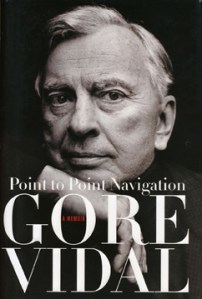
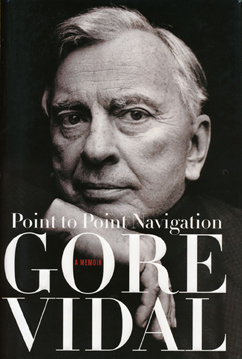
To Gore Vidal, a postwar literary lion who tried ever so hard to describe the world in a solipsistic idiom, decline was probably one of the most effective tools in his writer’s cassette. A winking, urbane snob who brandished wit often of the pun variety, an aristocrat who cried crocodile tears over American populism in ways mostly funny for their disingenuousness, a bitter crank who thought right wing bomber Timothy McVeigh’s and World Trade Center destroyer Osama bin Laden’s ideas deserved a day in court, a screenwriter who tried to inject transgressive ideas into Old Hollywood, Vidal left us last week, left us daring even to feel sentimental blush for his passing, since love was a frippery subject to him. For some of us, especially those with literary leanings, the news, unremarkable given his ill health, still likely caused a frisson of competitive writer’s id, the need to for one last moment perhaps feel competitive with a gilded age of public intellectuals, whose pungent, elegant sentences were something to be savored like brandy notes, not minced up on Twitter. We are hypocrites, though, as Gore Vidal realized, because in the 24 hour news cycle, few of us prize the written word so much as we crave a melodrama. It helps us feel alive.

A few hundred years ago, we forget that men could be roasted over green logs for hours over fine points of religious heresy. Gore Vidal did not live in such an age, but instead trod one of banality, of Main Street peanut crunchers meeting his manicured polemic not with fire but with puffy eyed bafflement. And so his American age, as much as he’d like to frame it in terms of Caligula and the decline of the Empire, was not full of burning corpses, but of thumb suckers. People squabbling over parochial biases and narrow ideas. It’s not surprising that Christianity and communism both find so many adherents in such an age–these philosophies both place the helpless individual into a historical narrative–communists see themselves as part of the materialist struggle on its way to revolution while Christians see themselves as soldiers in a battle for the heavens. This urge to frame one’s life in a higher context was no less tempting to Gore Vidal, who saw the decline of republicanism into imperialism as an inexorable thrust of history, and imagined himself as Cicero  standing at the pillar. He called himself a solipsist and joked that the rest of us were figments of his imagination. This kind of bold artist’s statement impresses those of us with less gusto, but only until we realize that Madonna and Tom Cruise probably see things the same way, and they sound less like cranky old farts.

The irony of such curmudgeons is how often they leave the world as beloved as Mother Teresa. Note the fawning obituaries recalling him with a sentimentality he would seldom show others. Of course, in this age of “Obit Hits,” we have a few naysayers: Here’s a savage attack on Vidal by Slate, if you like the taste of blood.

I have a few Gore Vidal novels at home, and though one can’t help but be impressed by his erudition, in many ways his desire to stand outside of history as a monitor meant he was left aside by some of the most exciting ideas in the 20th century. He thought Bob Dylan wrote terrible lyrics. He dismissed Thomas Pynchon because he thought “Gravity’s Rainbow” was unreadable (i.e., he didn’t understand it, and there’s a pathetic essay out there preserving that ignorance for posterity). At the end of the day, as he fought for the value of letters in an illiterate society, he probably didn’t know how much he sounded like the grumpy old men of the right after their declaration of culture wars. He didn’t seem to get, with his enlightenment superciliousness, that the 20th century belonged to irrationalism. Freud and Jung’s science may have had little basis in fact, but their interpretations of history offered guideposts for an age in which we found out particles’ positions and directions couldn’t be determined at the same time. When mass slaughter could be contrived by a few people with sick beliefs. The realm of the unconscious seemed to hold no guerdon for Gore, and so we are left only with his cleverness and its limitations. If Vidal had anything else in common with Christopher Hitchens, his also recently departed “dauphin,” it was that both seemed to think that the highest form of consciousness was spotting vulgarism and irony, and that those with such radar were society’s saviors. As if all the other forms of intelligence and consciousness and aesthetic barely mention a footnote.  For that reason, Vidal’s novels can feel awfully limited and contrived–more likely to cause titters than cries of “Eureka!” Gore Vidal seemed bent in impressing us and bullying us into seeing the world his way than on pursuing the humbling task more native to the great artists–discovery, with a bit of humility.

Seeing himself as a historical figure, he seemed to write about history in first person a lot. “Look, there’s me with Tennessee Williams in the late ’40s. Already, my serious mien suggests I see trouble in the postwar era.” Or, “Hey, look, there’s me blowing the lid off the Oklahoma City bombing story. Adding my stamp to your understanding because mass murder by an extremist doesn’t explain itself well enough.” “Look, there’s me with Jackie Kennedy as she explains after-sex douching.” “Look, there’s me not being liked by the Kennedys anymore.” Whether the subject was Occam’s razor or McVeigh, Vidal was ineffably gifted in starting the sentence with “I.” Historians might wrestle with each other over the Great Man Theory of history, but Gore Vidal was constantly able to show that when it comes to being a Great Man in History, 90% of success is showing up.

Did he mention that he was good looking? And that his enemies weren’t? He boasted of his sexual exploits and his lack of concern with others’ pleasure, even those he bedded. He informed us that he was not capable of sexual jealousy or love (besides the love of his long-lost school fere “Jimmy Trimble,” killed in World War II.) He claimed to have taken Jack Kerouac upstairs to one of the rooms in the Chelsea Hotel to play horses and mares and wondered if the registry would become famous. Yes, Gore Vidal helped illuminate hypocrisy, especially sexual hypocrisy in a way that was to offer pathways to liberation for homosexuals. But he didn’t embrace the gay movement so much as he insisted that everybody was secretly bisexual and just wouldn’t admit it. Why? Because he was. If we admit he helped history along, we also have to admit he did it in the way that only an unabashed narcissist could–with a Napoleonic, indefatigable belief that everything he did was right, a belief bestowed him by his patrician upbringing among the rich and powerful. (His grandfather was Senator Thomas Gore of Oklahoma.)

You can take his word for it, and if you were scared of him, you probably would. And yet he was surpassed on so many levels by people with a better understanding of the spirit of the age.

He also liked to attack people for their looks and once said that narcissists are just people better looking than you, i.e., him. You can trace ad hominem attacks back further than Vidal, surely, but he made it urbane and witty to attack persons (He said Will Hays looked like Mickey Mouse) and that likely inspired ferocious leftists of the current day (like those on the Daily Kos blog, whose authors do the same, albeit without the wit or elegance). You could easily say that his crankiness and flights of paranoid conspiracy mongering in his last 15 years ought to be excused because of his age. Vidal isn’t the first sharp intellect (Vonnegut is another sad example) who turned shrill, uncompromising and humorless in dotage. But he was calling his adversaries Nazis (William F. Buckely) and comparing them to Charles Manson (Norman Mailer) in the 1960s. So Vidal’s affable curmudgeon routine could also be seen as less a sad effect of age and more of a sclerotic hardening of bad qualities he’d always had. You might not notice because he was always willing to gossip about whom he’d fucked, which made him more fun than, say, Noam Chomsky.

But can I miss the writer? Yes. Sometimes. Myra Breckinridge is very funny. Not as funny or Vonnegut or Pynchon or Southern, but funny. In his cramped way, Gore Vidal illuminated sexual and political hypocrisy, albeit with reductionist obsessions. He championed numerous writers like Italo Calvino and Dawn Powell who might have been forgotten. He endured blacklisting after writing an openly gay novel (in the ’40s!) and made it his job to blast accepted history. The latter is not a fun job. It requires constantly questioning the underpinnings of your beliefs, especially about the world you live in and who was really a hero, who was foolish, and who bought their way into more acceptability. He knew. Because he had crawled around in that world himself, one he claimed he had tried, with some success, to leave. Fighting accepted history is like taking out garbage. You will be doing it forever if you do it right.

My fondest memory of Gore Vidal is, oddly, as an actor. He played a cameo role of a garrulous priest in the film Igby Goes Down, which also starred his pal Susan Sarandon. Vidal has a brief monologue in which he is giddy describing the joys of the fall leaves. Vidal, whose famous vanity surprisingly didn’t lead to an acting career, is positively ebullient in his small role talking the trivialities of a fool. Seeing him work so hard to fake warmth made me feel warm. It redeemed a lot of his literary work, which has always left me impressed, sometimes titillated, but nevertheless a little cold afterward with no one to hug. Maybe only the memory of the beloved J.T.

A new Yahoo story today shows that gun sales have spiked after last week’s shooting massacre in an Aurora, Colo. movie theater.

I’m sure I don’t have to state the obvious … well, yes I do. Lots of gun nuts out have over the past couple of years scrounged up the counterintuitive argument that massacres like these could be prevented if more people were armed. That means, if tons of guns were dropped in a crime-ridden inner-city area like Detroit, crime rates would drop. It would mean that if guns were airlifted to a war zone like Syria and dropped down to both sides, violence would stop.

We’ve already been through this obscenely stupid argument before. When Gabrielle Giffords was shot, along with several others, in a Tucson, Ariz. parking lot early last year, one of the people to rush to the scene was the armed Joe Zamudio. He came with his gun drawn to the scene with the safety off and caught sight of a man with another gun. This was not the shooter. But Zamudio didn’t figure that out immediately and pushed the man up against the wall. Luckily he had the presence of mind not to shoot, but things could have spun out of control. He also knew, according to Slate, that if he pulled his gun out he might be confused as the shooter.

Common sense tells us that when everybody is armed, situations easily defused could turn into life and death emergencies. People who feel threatened are oftentimes mistaken, or even if they aren’t, they aren’t likely to judge whether they are really in mortal danger. Guns give people a false sense of power, when the power they won’t really ever have–unless they are criminals–is that of surprise. And that is always left to a hostile person with a weapon. For this person, the right wing is willing to fight tooth and nail, because a schizophrenic’s access to firepower as a key assumption of their own liberty, a supposed bedrock of their own Rousseauian natural rights.

This is one of those diminishing return arguments–it goes nowhere, but gun fanatics will argue it because they know you are too afraid to fight it to its dead end–nonsense.

The more untenable their arguments, and the more grisly statistics about gun deaths give them the lie, gun rights advocates grow more ruddy faced and extreme about their conviction and engage in the most childish forms of projection: It’s not guns that are bad. It’s got to be anything else. Everything else.

What are we blaming the Aurora, Colo. theater shooting on, other than lax gun laws:

–*The Batman movie

–*Tough Ph.D. programs

–*Lax prescription drug laws

–*Poor parenting

–*The right to peaceably assemble

–*Red hair dye

–*People’s lack of access to full body armor

–*Tear gas

–*Too-long movie ads

–*Liberals. Because just saying that word makes certain neanderthals pee blood.

–*Government control of our grammar structure

–*Government control of Social Security

–*Government control of the post office

–*Government control of reserve currency

–*Yo Gabba Gabba went off the air

–*The health care bill

–*Abortion rights

–*Hillary Clinton killed Vince Foster, I tell you

–*Mexican immigrants taking all the jobs

–*Anything other than guns because we have a Second Amendment people and that means if you restrict schizophrenics from acquiring assault rifles, you’re limiting my personal freedom.

… Or maybe we can take the “quotes” off Obamacare now, a sneering portmanteau word used almost exclusively by detractors of the 2010 Patient Protection and Affordable Care Act. Now that the law has been upheld by the Supreme Court, perhaps the pejorative meaning will someday disappear, and posterity will be kinder to the word, a herald of a time when millions of people got health care insurance, and it will cease to be used as a horrible shibboleth by a certain kind of American breed who insist that suffering is the mandatory price of freedom.

At the very least, this morning, we have avoided the distasteful sight of watching a small number of partisans carry on in front of the world and actually cheer for the vulnerability and frailty of their fellow countrymen. “Let ’em die,” as Republican conventioneers like to yell at the uninsured, ought to be the standard for sneers, not “Obamacare.”