I’m proud to announce that my 40th album, Faint Heart, is hitting the streaming services this week. This one comprises piano songs, including some pop and folk numbers as well as a number of wholly improvised instrumental pieces.
If someone ever asks me how I started playing piano, I’ve got this quick answer at the ready: “I stared at the piano for 45 years, and then one day put my hands down on it and started moving my fingers around.”
A funny joke … if perhaps only somewhat true. In fact, I had a piano in my house for many years as I was growing up. But I was mostly afraid to do anything with it other than learn “Happy Birthday.” My parents had some stuff they liked to play (I remember my father liked playing “Green Green Grass of Home.”) But mostly I remember the family piano being ignored … and in hindsight think of all the opportunity wasted because I was too afraid to play it. We eventually abandoned our family piano (or sold it, I don’t remember) after we moved into a mobile home and couldn’t put it anywhere.
When I was in my 20s and in college, a roommate’s or friend’s keyboard would occasionally slip into my hands and I would add some notes to a guitar project I was working on. But it was just to add color or timbre to my arrangements. Later on, I threw some one-handed piano parts onto my recordings with a MIDI keyboard. When I learned I could program these, I asked myself, “What the hell did I buy this expensive-ass keyboard for?”
Everything changed when my wife got me an iPhone with GarageBand in 2016. I don’t want to turn this into an advertisement for Apple (Tim Cook doesn’t need my help) but occasionally I would run my fingers along the keyboard on the screen, playing along with some electronic thing I’d written, and some not-horrible music would come out. At one point I thought to myself, “Either these GarageBand developers are geniuses and make me sound like a piano player when I’m not … or I have some actual talent at this instrument.” I later composed a full piano piece, playing the right-hand and left-hand parts separately with my right hand on the keyboard. I’m proud of that piece, but I wouldn’t brag about the performance. Eventually, I turned on a cheap tape recorder and tapped out a piece called “Otto Half Soft,” which is the first time I ever composed my own tune with both hands. Because I approach every music project with a punk attitude–assuming that instinct and imagination and raw emotion will always trump technique and skill–I got cocky enough to make a whole album of piano songs in 2018. It was called Yipano, and aside from a few leftover GarageBand pieces, it mostly features me playing a piano two handed. My advertising pitch for that album was: “Pay for the scandal of hearing me learn how to play the piano in real time.” I figured it would drive away what few fans I have, yet I picked up some new ones. Some of the songs get listened to on TikTok.
I waited a few years to do something so arrogant again. The reason it’s happening now is that my son recently got a new 88-key keyboard for his birthday and I wanted to test it out. (My son is a great piano player, and has been trained properly, unlike his dad.) Usually, it’s when I’m “testing equipment” that I start accidentally writing new material. I like this method because the last thing you want to do when you’re writing is overthink.
The upshot is that I squeezed out 15 new songs over the last six weeks, and the result is Faint Heart. I had a lot of unused lyrics left over from past projects, so there’s quite a few new sung songs as well, something to keep things flowing if you get bored with the piano improvisations, classical pretensions or general arrogance of a project like this.
As usual, the new album was written and performed by yours truly in my home studio in New York in July and August. The album cover photo was taken by Natasha Zakharova.
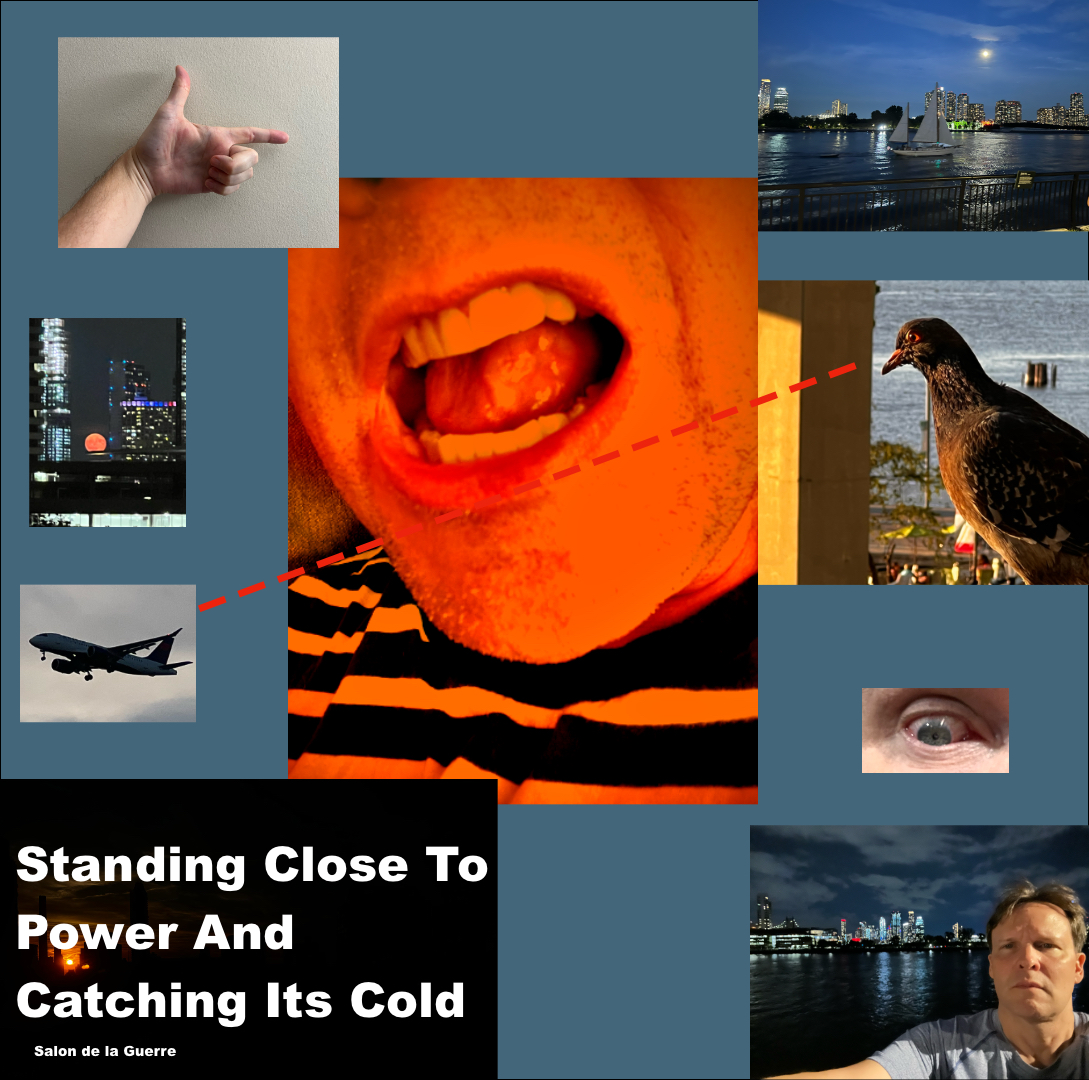
I am very proud to announce the latest alternative-rock album by Salon de la Guerre: It’s called Standing Close To Power and Catching Its Cold, and it’s now available on all the major streaming services, including Amazon, YouTube, Spotify, Pandora, Apple Music and Bandcamp, as well as other places where music is (still) sold.
Like all my albums, this one is available only digitally.
I’m also proud to announce that with this release, I now have 500 copyrighted songs in circulation. I’m chuffed about this for a number of reasons, the most important of which is that even though I’m an aging guy, I feel like I’m in my creative prime. When I was in my 20s and confused and sad and unproductive most of the time, the conventional wisdom says my art should have been much better. And yet most of the art I made in my 20s was horrible shit.
Things got better in my 30s, really good in my 40s, and now here I am in my 50s, a husband and dad, churning out stuff that I think rocks pretty hard and certainly sounds like the best stuff I’ve ever made. I feel more lyrically focused too. And dare I say it, as someone who never thought of myself as a singer, I now don’t hate my voice anymore.
The new album was designed to be punk rock with two guitars trading off leads. That probably puts me closer to the Replacements than the Ramones this time out. There are a couple of notable exceptions in the stylistic approach: The first song, called “This Town Needs Secrets,” is my first ’70s style power pop song. I did not make it that way on purpose. Sometimes, as you’re producing a song (or any piece of art, really), putting together the random pieces, you realize what it’s becoming, and at that point it’s your job to just get out of the way and let it live.
The last song on the album, “The World’s Pain Leaked Through Her Shirt,” is an electronic piece composed on Apple’s Logic Pro X. It wasn’t guitar rock. In fact, it was more like an outtake from a previous bunch of songs I made two years ago when my mindset was more about the Talking Heads. But the song seemed flippant enough to qualify as punk.
The lyrics seem to be (since I don’t plan those either) about the desires and angers that seethe in domesticity, as well as sexual politics and gossipy little towns (not unlike one I used to live in). I’ve thrown in some allusions to my favorite poets for those interested in hunting for that kind of thing.
As always, the album was written, performed, arranged and produced by yours truly at my home studio in New York. I’m responsible for all the guitar parts; the rest of the sounds were made with my terrific Logic Pro software. (I also designed the cover.)
22 History Rich Titanic survivor recalls harrowing moment ship ran out of olives.
21 Bravo “Below Deck”: The audience patiently awaits a mutiny, even if it might take years.
23 PBS “Frontline”: The complicated ethics of exaggerating the size of some ethical questions.
25 ABC Battle of the Network Wonks
45 HBO A tantalizing documentary about an HBO show that may or may not have hired intimacy coordinators. It’s hot-t-t-t-t-t!
72 Bravo “Finding Your Roots” discovers a lot of old farmers.
89 ESPN We’re going to keep mixing sports frivolously. Up next: “Pickleball Meets Monster Energy Supercross.”
170 C-SPAN 2 Here’s where you can find out about all the books you might otherwise be reading if you weren’t watching a TV show about books.
32 Nickelodeon Movie: “Henry Danger Has Lukewarm Date With Dale Prudent.”
82 HGTV How to upgrade the vestibule the cops have locked you in during a university protest sweep.
96 Tubi This episode of “Body Fixers” offers extra blood and pus.
98 C-SPAN South Dakota governor Kristi Noem advocates for “Secretary of Dog Killing” as new cabinet position.
96 Tubi “Body Fixers” discovers what’s really wrong with your hair extensions: You have borderline personality disorder.
72 Bravo “Vanderpump Rules” explores the allure of forbidden love but asks how forbidden it really is when everybody knows that it’s going to result in ratings that are very much bidden.
101 CNN Israel-Palestine: How your extreme thinking on a complicated issue is going to make everything better, according to the people you are taking social cues from at this moment.
86 TBN Good news! Grace just got a lot more affordable!
86 TBN As we watch people dissolve into their own solipsistic and bloodthirsty belief systems, we’re reminded that morality is sometimes best left to the professionals at AutoZone.
I am very proud to announce the release of Salon de la Guerre’s 38th album, a work of electronic music with futuristic themes called How Do You Bleep? As of today, the album is available on all the major streaming services, including Apple Music, Amazon, Spotify, Pandora, YouTube and Bandcamp.
As I say on my music page, the album is a work of electronica and dance numbers with lyrics on futurism. The songs are often about robots and their attempts to live like humans in a world where humans are noticeably absent. The album imagines a future of both plenty and scarcity and ponders when feelings (such as love) are both natural and programmed.
Why this? Why now? After all, just four days ago I put out a classical album, and the week before that a slate of folk songs, coming on the heels of a garage rock album a couple of months ago and another classical album a month before that. I’m starting to sheepishly feel as if I’m watering the world with too much music, released in a schizophrenic genres, to the dismay and consternation and possible irritation of my few fans.
The answer is straightforward: A lot of this stuff had simply been backing up.
In 2022, I consciously decided to stop making music for a while. I’d just put out a garage rock album I was quite proud of and thought it might represent the height of my abilities; I thought maybe I should turn my attention back to fiction. Because I can’t help twiddling, however, I decided to put a bunch of electronica bleeps together with my wonderful Logic Pro X software, inspired by Talking Heads songs and some other acts. Rather than rush to finish it, I asked a friend if he’d like to collaborate. He’s a busy guy, so he toyed with one song but otherwise had to go back to his many other more fruitful endeavors.
So there my electronica album of goofball bleeps sat for two years gathering dust. After I finished the first draft of a novel in 2023, I started thinking of music again, especially when my son said he wanted help with a music project. So I pulled out my prized RODE shotgun boom mic, the same one my wife and I used to shoot The Retributioners. Real musicians laugh at me, but I used this mic for a decade to record all Salon de la Guerre vocals. I liked its sound. I also didn’t want to plunge $400 into a dedicated studio mic, one that might not plug into my iPhone. (Again, I jam econo.) But last year my RODE finally died and I had to slosh around some funds so I could purchase better gear. That took some time to iron out.
At the same time, I’d started gathering together some folk songs, since I tend to write songs so often these days I’m often doing it in my sleep. Here, too, I was frustrated because the very old guitar my late mother had given me developed a buzzy fret. It ruined the sound of some of my fragile folk numbers. I was looking at either spending a lot of money to fix a very old instrument or replacing it altogether (I don’t get sentimental about much anymore, but I make an exception for this workhorse dreadnought acoustic guitar. … Did I mention my late mother bought it for me?) I walked the thing down to a basement in the Village, where an old longhair whose workshop was not much bigger than a walk-in closet gazed over my acoustic guitar, threw it into a vise, gave it two or three sharp thwacks with a hammer, and immediately removed the buzz. He said he didn’t need cash but instead offered to take possession of a broken practice bass I’d brought along. It was the most 1960s transaction ever.
By the end of last year, I had all the gear I needed to not only dive back into new material but to finally yank my electronic album out of mothballs and finish the vocals.
Sorry for the long story.
How Do You Bleep? was composed and performed by me in my home studio in 2022 and 2024. I produced all the tracks except for one: “Lead Me To Your Robot Heaven in the Mountains,” which which was co-produced by my brilliant friend Christian Montalbano. Christian thought the Logic Pro sounds in my original version were a bit cheesy and he switched them out for better instruments and offered a more fluid beat, for which I’m eternally grateful. You can check out Christian’s amazing music here.
I also provided the cover art for this one. You can listen to a sample of the new album here:
The new music barrage continues. Earlier this week, Salon de la Guerre (the name I use for my musical act) released its 37th album, called The Tug Fork War. The album is now available for streaming on YouTube, Bandcamp, Amazon, Apple Music, Spotify and Pandora, among other platforms. You can also make Tiktok videos with it (at least until that platform is banned).
In the past, my classical albums have used thematic concepts and they usually outlined the story of a character and his or her adventures (someone whose identity and story lines are revealed only from the song titles). The new album didn’t seem to have any narrative qualities and instead was tapped from a stream of pure abstraction and my love of Sergei Prokofiev’s work. The title is a very veiled reference to a piece of Americana, but there’s no need to read too much into it.
As always, this was an excuse for me to discover new stuff: specifically to find more dynamic ways to voice the notes in my computer software and get them to sound less like … computer software. (The album was created on Logic Pro X and GarageBand, some of it made with a scoring tool and some of it played by me on an iPhone screen keyboard. … Yes, I sometimes make music the way other people play video games.) Maybe the day will come when I can actually score a work for a live string quartet, but I file that dream under “Things I would do if I had a geyser of money shooting up from my sink drains and toilet, horror movie style.” As the Minutemen might have said, over here at Chez Rasmussen, we jam econo.
I’m including the first track of The Tug Fork War here. But, as I promised, there’s more to come. This week I also have an electronica work coming out with futuristic themes. Aren’t you lucky! Until then, watch this space for random smatterings of poetry and the occasional comedy bit.
(The cover photo of the model on The Tug Fork War was taken by VladimirFLoyd.)
Facts are poor and pissing things Lost in a green lawn Where the pool was shocked For eyes to be stung Facts have no meaning unless shrieked Screamed so loud they stress the picture window and its scoop of suburb to point of fracture A scream smoked and peaty and single malt “You kept sleeping you bitch when you heard our daughter had snuck out. Get out of that bed now.” And then a gun made its appearance Oddly shy and quiet the .357 Serving as punctuation, an exclamation point On a husband’s scattered thoughts Words too fussily labored over This fact gone went missing amid the ph-balanced water Gushing the next day from the side of the pool Like innocence aborted Forgotten, all this that happened, In a Sunday scrum over a steaming fowl.
I’m proud to announce (or I regret to inform you, depending on your musical tastes) that I have yet another album out.
Salon de la Guerre’s 36th album, No One Hears a Zen Busker, has arrived on the streaming services. For whatever reason, I’m enjoying an extremely prolific phase in my songwriting and composing career. I’ve released three albums in the last four months and I have two more dropping in the next few weeks.
I know it’s hard to keep track of, and I’m sorry if my curating skills aren’t the equal of my ability to keep churning music out as if by fire hose.
The latest set is (mostly) acoustic folk songs. I like composing on guitar, but I’ve had technical problems (including the death of my most expensive beloved microphone) that kept me from recording acoustic guitar properly for a while, which is why I haven’t released such an album since 2017, when I dropped Keep Your Slut Lamp Burning. Like that collection, this new one is about eccentric characters and folk heroes, both modern and classic. It includes Americana experiments (including a song inspired by Ambrose Bierce) and meditations on despair and joy. The usual Salon de la Guerre territory.
The album is now available on Spotify, Apple Music, YouTube, Amazon, Bandcamp and Pandora, among other places music is streamed. Unfortunately, I still do not offer physical CDs, which would be too expensive and make this little side endeavor of mine a bit too expensive to continue.
Even as I write this blog, I’m already thinking ahead to the release of my next album, which is coming out next Monday. That one is another detour into classical music and finds me continuing in my quest to play in the fields of Prokofiev. I’ll let you know when it arrives on the streaming services.
Until then, please enjoy a sample of No One Hears a Zen Busker. As always, the music was written, performed and produced by me, Eric Randolph Rasmussen, and it was recorded at my home studio in New York City in the early months of 2024. I also took the cover photo.
Something to hold Something to wrangle They put your soul in a jail Your ribs in a mangle
The daylight that struck you through She knew the light in your eye Was reflected pages of other people’s news The cauterizing fish Sealed fate in memories of stew
And a mother dressed as a stove Hove a dish as easy as a sorry slur Then sorry to have spoken or to have moved I am both of them, thrower and thrown Unleashed to anger when in the throat it should be sewn
I am my father’s yell and my mother’s quiet And you could see in the long genetic party of the bridegroom pictures Some 60 eyes of generations looking through Looking through you
And you hove with all of them To make the play twist forward You are the screw
Eric R. Rasmussen is a novelist, composer, journalist and filmmaker. He is the author of ten novels, including the three-volume work The Ghost and the Hemispheres. He is the sole force behind the musical act Salon De La Guerre. And he is the writer/director of the online Web comedy series “The Retributioners” starring Stephanie Faith Scott.



 Beauty is Imperfection