Feeds:
Posts
Comments

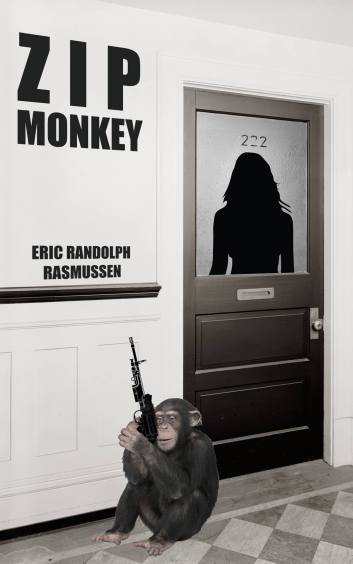
[The following is an excerpt from my novel, Zip Monkey, which I plan to release in the upcoming months. Copyright 2012. Cover art by Corey Brian Sanders.]Zip Monkey Cover 2
Christina Brostrom looked out onto the grounds of the college holding a coffee cup up to her face gently, so that the steam would open her pores a bit. This was part of her ritual of drinking hot tea with Stevia, a cup of inspiration with which she greeted every morning. She knew that ritual was a foundation of wisdom. Or would be, were she ever to become wise.

On the desk next to her computer screen was a greeting card of forced congratulations from her co-workers out in the cubicle pit. Lots of “Congrats, girl!” and “I knew you could do its!” scrawled across the card to celebrate her promotion. But every laconic “Congrats” betrayed bitter envy. Christina had been in her position only a year. And now somehow she’d gotten a big promotion, seemingly for no reason. When they were saying, “Congrats,” what they really meant to say was, “Who the fuck do you think you are?”

And they were right. She didn’t deserve it. She was just a pretty face who’d done it with the right guy. She remembered her mother’s joke, “With a vagina, you can go anywhere,” which wasn’t really a joke. Christina had bartered her sex appeal for a job as a Level 6 grants and contracts manager. Not too shabby.

Ralph Bliagos was nowhere to be found, of course. He had defiled her, promoted her, disappeared and left stacks and stacks of data on her desk to reconcile—enough work to last her a year. Most of it paperwork for live animal research grants that would be submitted to the National Institutes of Health (“NIH.”) Her first job, according to a memo, was to haggle with somebody from the Institute of Animal Research Studies for a $100 discount on a crate of pre-diseased mice. A hundred of the 1,400 mice were dead already when the box came in. Certainly that was worth at least two hundred dollars off, said the dean to Christina in an e-mail.

Before this, her job had been to do simple data entry, making sure the lab equipment codes matched the inventory. But increasingly, after an audit of the university and a fine from the New Jersey attorney general’s office, she found herself actually making decisions on how procedures were coded. That was way above the pay grade of a 23-year-old intern. Checks made out to the university for thousands of dollars started fluttering onto her desk. She didn’t know what to do with them. Nobody claimed them. She put them in a folder with dollar signs marked on it.

The Grants and Contracts Dept., hidden behind leafy plane trees in a white travertine campus tucked away from the road, was a huge vein of money for Mount St. Catherine’s University. While Ph.D’s elsewhere at the university lost their jobs during Congress’s sequestration, Ralph Bliagos’s department was somehow thriving, his money spigot still pumping. “How could this be?” Nobody wanted to ask that question. “Just keep growing the pie,” said the dean’s office. Ralph’s enemies raised questions, of course. Grants and contracts had an ongoing Hatfield and McCoy-style feud going on with the dicks in finance. Christina was even told she shouldn’t be seen having lunch on campus with her friend Judy who worked in the finance department.

“Wouldn’t look good,” said Bliagos. “You gossip with Judy Freeman, and it’ll get back to me. She’s waiting to find out we’re doing something wrong.”

“Well then, who should I have lunch with?”

“How about me?”

That’s how it had started.

Bliagos was 13 years older than Christina. He seemed to know a lot about a lot of different things. He’d played guitar in a band in college and knew about music publishing rights. He knew about trademark law after working as a paralegal. He even knew about dance.

“You can’t really separate Merce Cunningham from Eastern religion,” he’d said.

A year later, Christina, the former star of the Cape May High School ballet, now older and wiser, realized Ralph had pulled the Cunningham bit out of his ass. But at the time he said it, she’d been smitten. Though he was older, he had an eternal boyishness—his averred belief in the inherent goodness of all people touched Christina’s heart and parted her knees—knees weak from naivety and a 2005 arabesque accident that shattered her bones and dreams forever.

All dancers hurt their knees. But Christina Brostrom had somehow managed to pull her kneecap apart after momentous thigh contraction while doing the Black Swan in front of 200 provincial New Jersey ballet fans. The audience was mesmerized by the plangent screams of this shining young dancer and swept up into standing ovation as several male dancers in blue doublets with silver galloons with the strength of apes carried her out the back door to the nearest emergency room.

Christina had always been rather keyed up and anxious, dancing as fast as she could, and even her mother opined that the injury was no accident, but a cry for help. She insisted her daughter was getting back at her. Christina had avoided a proper warm up and fragged herself on purpose, said Mom, whom everything was about. Mother Marla Brostrom was a semi-famous psychoanalyst and believed there were no accidents. Everything bad that happened was an act of sublimated feelings, even a fall down the stairs or choking on a hot dog.

The adjustment from ballerina to clerical assistant was remarkably easy for Christina Brostrom. Gone was the anxious, excited ballerina whose fast-rising stardom made every day a birthday party thrown just for her. Now it was all just workaday world narcosis, interoffice birthday cards to people she’d never met, and hot pocket microwave lunches in rooms with receding slate colors. Instead of jetés and soubresauts, Christina could now pursue the drama of office gossip, hear temper tantrums through the walls and smack insolent fax machines. And there, holding on to the handle of a 2005 Honda Civic every afternoon with wolfish teeth was Ralph Bliagos. Ralph, with his round, McCartney-ish eyes, big hands and hair extensions. He seemed to know her dreams, and his adoring eyes reflected the star she’d dreamed of being. Or at least that’s what she was thinking when she went down on him in the Honda. The thrilling, fleeting, naughty affair. The sweaty, heart-beat-skipping rendezvous every night in the office where they had started somehow fucking and committing government billing fraud in no particular order.

Ralph’s the one who taught her to do it. First he showed her how to double bill for clinical trials—the university charged Medicaid and Medicare money for lab work on volunteers even though the companies sponsoring the clinical trials on the devices and drugs were already paying. It was a surefire way to rip off Uncle Sam, something Ralph had learned at a couple of research universities. He also taught Christina how to “unbundle” the lab tests, coding a bunch of blood tests separately when they should have been billed together. Apart, they were worth more money.

To Christina, it was kind of like playing Candy Crush Saga or Asteroids. “Unbundle. Duplicate. Recode.” It seemed more naughty than illegal. “Girl! You’re bad! Ha-ha!”

“It’s just us printing money,” Ralph had said. “Everybody does it. At the end of the day, who cares? We’re curing diseases.” She wanted to impress her boss, and as she separated centrifuge work, she was actually whistling.

It only slowly dawned on her that what they were doing was actually very much against the law. But she was already in it way over her head by that time. Her signatures were all over everything.

It was only in month three, long after Ralph had given her the first bladder infection, that he asked her out to a movie. He confessed then that, yes, he had been engaged to somebody for three years. But his fiancée, Dina, was an argumentative, hatchet-faced bitch troll attorney, and he insisted he was going to break it off with her. Dina didn’t understand him, he said. She didn’t listen to Rush. She didn’t like white water rafting. She didn’t know who Merce Cunningham was.

“But you,” he said to Christina. “You’re an open book. Everything is still possible and hopeful for you.” This appealed to her in part because neither statement was actually true. She, in fact, had fallen south in ways only people with the lost promise of true greatness can fall.

He had made love to her gently and sweetly the first time. His feet stuck out the open window of the Honda and he swore it didn’t hurt. Later, as they lay together naked in a dark brindled cowhide rug from Bed Bath & Beyond, he imagined them going to someplace romantic. Like Nova Scotia. Or Atlantic City. Christina was breathless. She had a dangerous love and a job she was good at. She was now a person like other people.

The morning of her surprise promotion, she crept over to the files and sorted through them. Three doctors in cardiology wanted to test a vasodilator and needed to make sure the NIH didn’t reject them again. The last time around, the government quibbled because the doctors testing the equipment held small equity shares (indirectly) in the company that made the dilator, and that would likely bias their research. Ralph turned to Christina one afternoon and asked her directly: “How would you make this problem go away?”

It was her first real executive decision: and it was something she was intensely proud of, because no one else would have ever thought of it. She simply moved the money over from another grant. She piggy-backed the vasodilator work onto a research grant for rheumatoid arthritis medication the doctors were also working on. Nobody asked questions. All the doctors knew was that the money they needed was suddenly there. “Doctors,” Ralph said, “must remain innocent.”

Christina Brostrom, the girl in the church choir, the girl who sang “A Mighty Fortress Is Our God,” the girl who made Frank Rich cry when she performed in The Nutcracker at age 12, was not, after all, born to be a ballet dancer. Christina Brostrom was born to be a criminal.

Yipano

Over the next two weeks, I’ll be releasing two new albums under the name of my musical act “Salon de la Guerre.” The first, Yipano, comes out Monday and is my first-ever album of piano compositions, some with lyrics, others totally instrumental. The other is an album of punk songs called You’re Going To Regret What You Did.

Here is a sample of the former, a song called “The Donner Party Follies.” Enjoy.

Still Good

I ran home

To see if the poem I had written was still good

Last night’s meat was all over the kitchen

There were things to unpack and stuff to toss out

You forget and you are hungry again

Just for fun …

Since forever, women have endured the calumny that they aren’t good leaders because they are too emotional, irrational, non-competitive, and weak to oversee or be equals with men in the workplace. What harm would it do if for a while we indulge the opposite conclusion: that men are too territorial, unitasking, uncooperative, combative, and prone to sexual stimulation to be leaders, to be over-represented in the workforce or be overcompensated in pay? Just for fun, what if we thought that way for a while?

A recent story about a legal win for DIY makers of murder weapons:

The psychopath in this video doesn’t care if criminals, children or the mentally ill can make homemade assault rifles as long as it comports with his vision that everybody should get a weapon by natural right. He calls it the end of gun control and we are supposed to shrug, arm everyone and hope that everybody being armed will work itself out. It won’t. Guns favor angry people who shoot first, not defenders. They escalate fights into murders. They do not defend anywhere near as much as they kill innocents and no legitimate study says otherwise.

Guns do not give the same advantage to defenders because we do not honor old dueling rules when we shoot at each other. The most essential talent of a gun, which has no shield and no way of stopping other projectiles, is to shoot an unwary person in the back from 50 yards away. Its function: treachery, not defense. That is physics. And that is the reason we’ve had gun control laws in this country since its founding.

There’s a childish insistence among gun fans that the Second Amendment framers must have foreseen a future of citizens running around with mass murder weapons and thought it was OK. That is a dumb misreading of one half of one sentence of the Constitution, devoid of the context in which it was created, yet endlessly repeated by Americans for peer approval in their backyards. It is also a purposeful misreading by those with a pecuniary interest in selling the guns.

There is no more reason to accept that we must now live with untraceable guns anymore than we have to accept the fact of meth labs. We have laws for those labs and we can certainly make laws to stop people from making their own guns at home with tooling machines.

Gun laws work because they change the way weapons move around and change hands and often, yes, laws can stop a murder at point of sale (more than 3 million sales were stopped since the Brady Bill passed in the early 90s, something beyond the understanding of your average gun fan).

The only things stopping us from further controlling weapons are mental constructs: a misunderstanding of the Constitution, a misunderstanding of our history, a misunderstanding of what freedom is and who gets to have it, and a sense of nihilism and hopelessness that gun nuts are so determined that there’s nothing we can do to stop them. Or we can give in to the fallacy that guns are part of America, always have been and that we’ll always have to live with an increased risk of sudden violent death as the price of freedom. That’s not idealism. That’s medievalism: Tolerating horror to preserve somebody else’s traditions.

Gun nuts are putting our lives at risk for things they don’t know, won’t know, don’t understand, can’t read and won’t read. They put our children’s lives at risk because their curiosity and any normal intellectual inquiry about the harm they might be causing stops if it forces them to question their own behavior and (even more ridiculous) their identities.

Gun liberty has nothing to do with preserving what America is. This is like any other place: You fix things when they are broken and you don’t use folk traditions as an excuse not to. People like this have no right to make us live in fear.


The Issue …

The issue is not mental health. The issue is not violent video games. The issue is not a culture of death. The issue is not the breakup of the family. The issue is not black trench coats or goths or Marilyn Mason or whatever straw man that irresponsible people want to make up to defend their irresponsible behavior.

The issue is that we freely hand out weapons designed for mass murder and then hope nobody will mass murder with them.

Want to know a way you can help the world right now? Something you can do with very little effort? (I did it while folding my laundry.) You can call 202-224-3121 and speak with your senators and representative in Washington and tell them to oppose the “Concealed Carry Reciprocity” bills floating through Congress. These bills, if enacted, would force states with strong and effective gun laws to recognize permits from states whose laws are much weaker. It sounds like an innocuous, clinical name, “concealed carry reciprocity,” but it’s very dangerous. It allows the NRA to override and nullify local laws and rob people of the ability to make their own local safety decisions. It is the exact opposite of states’ rights. At the same time, it gives the gun lobby a way to pursue its real agenda, which is to put guns everywhere, when every study with any rigor and reproducibility says more guns equal more violent crime.
 
That’s more risk your family takes on for going to the movies, going to a concert, going to church and going to school. Soon, it could mean extra risk for New Yorkers going to Times Square, where they will have to confront less vetted or unvetted gun carriers.
 
The congressmen who introduced this measure are well funded by the NRA and know that it’s the organization’s top priority. The bills languished temporarily after the recent Las Vegas and Texas mass shootings, but they are moving forward now–this week.
 
Spokespeople in the offices of both my senator and House representative told me the same thing:
 
The best thing to do is call them! 202-224-3121. It takes very little time.

The Widowhood of Bunny Album Cover 2This week, I’m releasing my 14th album and my second symphonic/classical work. It’s called The Widowhood of Bunny, and it’s a sequel of sorts to my 2016 album Gravitas: A Life. Like the other album, it has a lot of jaunty classical piano and string arrangements (they remind my wife of movie soundtracks) but also some jazz elements inspired at least in part by 20th century masters such as George Gershwin and Aaron Copland. Like Gravitas, it’s an instrumental suite that follows the exploits of widow Bunny now that hubby Gravitas has dropped dead.

Like its predecessor, The Widowhood of Bunny was made on an iPhone 6S. Gravitas came together because I was stress-testing my phone and wanted to see how rich a sound I could get out of it — the project resulted, to my amusement, in my first 50-minute symphony. Bunny was a fluke, too, in a way. Earlier this year, I shoved a string section into one of my rock songs as a funny interruption (a satirical trick I learned from Frank Zappa that amuses me no end) and found the string part growing to almost five minutes long. I realized I would have to stop and either throw the incongruous thing in the trash as another dunce’s experiment, or save it by writing a new extended work. Then I wondered if my imagination could handle another long-form piece, and of course, idiot male posturing pride set in (“Why the hell not?”) and a determination to grow within this genre. My audience, after all, is small enough to not really give a shit.

Indeed, lately, I’ve been thinking … “Hmmmm … Son of Gravitas?”

I understand that the sing-songy, jaunty arrangements in these two albums could really turn off people who prefer my pop and rock tunes, annoy serious classical fans by thinking I’ve wandered into muzak or invite the deserved scorn heaped upon pretentious assholes everywhere. But I ask for patience: Bunny and works like it feed my rock music (and vice versa), and allow me to search and discover. I don’t know many good artists who can repeat themselves, even if they want to. I certainly can’t. It usually doesn’t work out for me to repeat concepts and stay within song genres, even if I’ve found a comfort zone within them. The minute I found my sweet spot in my singing voice, for example, I realized that relying on it made my songwriting weak.

But if you’re not a fan of this stuff, there’s good news: I’ve made four other albums this year, and through the luminous mysteries of music distributors, one of them is only days away. That one’s a neo-folk album of nothing but acoustic guitar songs, and I’ll be sharing that too, hopefully by the end of this week. The release of these two albums hopefully demonstrates to you my proud musical, schizophrenia and dedication to keeping it fresh.

I composed and produced the album during the summer of 2017. The work was created in Apple GarageBand for iPhone. Apple’s string arrangements are largely programed through manipulation and furious button pushing. However, Bunny‘s piano, electric piano, bassoon, flute, clarinet, oboe, glockenspiel, and bass violin parts were all performed by me on the program’s piano keyboard.

I’m including here the proper opening track off The Widowhood of Bunny (it follows a prologue). The album is now available on iTunes, Amazon, Spotify and other sites where music is (still) sold.


Imagine …

Imagine the evil of a man who demands blind loyalty from his followers; who preys upon their low self-esteem and insecurity, promising them pride they haven’t earned by offering them membership in a special tribal identity; who robs them of their individuality by offering them love and esteem in exchange for total deference; who deflects any questions about his competence or leadership by inventing bugaboos, weaving conspiracies and projecting his worst behavior onto his enemies and thus normalizing his behavior by claiming that it’s universal. Imagine his thorough success at this strategy is such that his followers eventually accept non-facts as fact, create their own argot that further alienates them from non-group members, turn violently on those who question the group dogma and otherwise allow their higher-brain qualities of doubt and inquiry to become neutered and destroyed.

And in other news, Charles Manson died.

Gun rights advocates say there are 2.5 million defensive gun uses a year. That’s 6,849 times a day. That’s how they justify ignoring the mass shootings of children.

To give their numbers context, let’s look at crime statistics:

In 2016, the FBI recorded 95,730 rapes. That’s 262 rapes a day.

The bureau recorded 17,250 murders. That’s about 47 murders per day.

There were 332,198 robberies nationwide in 2016. That’s 910 per day.

There were 803,007 aggravated assaults in 2016. That’s 2,200 per day.

If you add all these up, gun owners claimed to have stopped almost twice as many of the biggest crimes the FBI recorded actually happening in 2016. And if you consider that only about a third of American households have guns, you must come to the conclusion that the overwhelming amount of U.S. crime is actually being perpetuated against gun owners–in such vast amounts that if I were them, I would be afraid to leave the house.

There’s an easy way to avoid that paradox: They can admit their numbers are fraudulent. They are, in fact, 20 years old and based on a phone survey of *Americans whose stories were not externally validated by the study’s author. The reason gun owners tout these figures is a miscible concoction of fear, folk wisdom, peer approval and inherent trust in family members. In other words, the same qualities Bernie Madoff preyed upon.

If this were an insurance scam, it would work the same way: The unethical salesperson exaggerates the risk of failure, sells you a product that is actually riskier, then tells you to share that risk with others by telling them to buy it too. The problem with gun rights advocates, even if their hearts are in the right place, is that they have asked non-gun-owning two thirds of Americans to share risk that the unethical salesperson has laden them with (the heightened risk of getting shot), and help them participate in a demonstrable fraud.

Incidentally, there is a real number of defensive gun uses, and there’s little reason to believe it’s much higher than toddlers shooting themselves. It is easily canceled out by murders many times over. There are common sense physics reasons that guns are very limited as defensive weapons, but if you can’t understand that, I doubt you read this far. And if that’s the case, you’ll never know that the monster at the end of this story was you.

*I originally said mistakenly that this study was only of Floridians. It was a random phone national survey. However, the point remains that small sample data distorts meaningful results when you’re talking about rare events like defensive gun uses.