Feeds:
Posts
Comments

It is with great joy I announce that one of my very first screenplays has emerged from its yellowing state in a drawer to make the semi-finals of a film festival. Not just any film festival, but the Austin Film Festival, a major confab with big name producers, some of whom have generously placed my script among the top 20 in the comedy category out of some 2,000 entries.  The screenplay, called “Candy Rocks Doesn’t Grow Up,” depicts the rise and fall of a 10-year-old rock star.

This script has been around for a long time (I originally conceived it when I was 26) and I’m thrilled that I’ll finally get to tell producers about it!

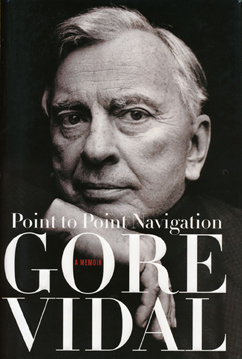
Lots of Gore

To live in an age of civilization decline sounds horrible, and yet also terribly attractive. People romanticize it all out of proportion to its actual reality, when science and history are often blind to it. But to a certain kind of writer, reveling more than he’d like to admit in Freudian death drive, it is delicious.

To Gore Vidal, a postwar literary lion who tried ever so hard to describe the world in a solipsistic idiom, decline was probably one of the most effective tools in his writer’s cassette. A winking, urbane snob who brandished wit often of the pun variety, an aristocrat who cried crocodile tears over American populism in ways mostly funny for their disingenuousness, a bitter crank who thought right wing bomber Timothy McVeigh’s and World Trade Center destroyer Osama bin Laden’s ideas deserved a day in court, a screenwriter who tried to inject transgressive ideas into Old Hollywood, Vidal left us last week, left us daring even to feel sentimental blush for his passing, since love was a frippery subject to him. For some of us, especially those with literary leanings, the news, unremarkable given his ill health, still likely caused a frisson of competitive writer’s id, the need to for one last moment perhaps feel competitive with a gilded age of public intellectuals, whose pungent, elegant sentences were something to be savored like brandy notes, not minced up on Twitter. We are hypocrites, though, as Gore Vidal realized, because in the 24 hour news cycle, few of us prize the written word so much as we crave a melodrama. It helps us feel alive.

A few hundred years ago, we forget that men could be roasted over green logs for hours over fine points of religious heresy. Gore Vidal did not live in such an age, but instead trod one of banality, of Main Street peanut crunchers meeting his manicured polemic not with fire but with puffy eyed bafflement. And so his American age, as much as he’d like to frame it in terms of Caligula and the decline of the Empire, was not full of burning corpses, but of thumb suckers. People squabbling over parochial biases and narrow ideas. It’s not surprising that Christianity and communism both find so many adherents in such an age–these philosophies both place the helpless individual into a historical narrative–communists see themselves as part of the materialist struggle on its way to revolution while Christians see themselves as soldiers in a battle for the heavens. This urge to frame one’s life in a higher context was no less tempting to Gore Vidal, who saw the decline of republicanism into imperialism as an inexorable thrust of history, and imagined himself as Cicero  standing at the pillar. He called himself a solipsist and joked that the rest of us were figments of his imagination. This kind of bold artist’s statement impresses those of us with less gusto, but only until we realize that Madonna and Tom Cruise probably see things the same way, and they sound less like cranky old farts.

The irony of such curmudgeons is how often they leave the world as beloved as Mother Teresa. Note the fawning obituaries recalling him with a sentimentality he would seldom show others. Of course, in this age of “Obit Hits,” we have a few naysayers: Here’s a savage attack on Vidal by Slate, if you like the taste of blood.

I have a few Gore Vidal novels at home, and though one can’t help but be impressed by his erudition, in many ways his desire to stand outside of history as a monitor meant he was left aside by some of the most exciting ideas in the 20th century. He thought Bob Dylan wrote terrible lyrics. He dismissed Thomas Pynchon because he thought “Gravity’s Rainbow” was unreadable (i.e., he didn’t understand it, and there’s a pathetic essay out there preserving that ignorance for posterity). At the end of the day, as he fought for the value of letters in an illiterate society, he probably didn’t know how much he sounded like the grumpy old men of the right after their declaration of culture wars. He didn’t seem to get, with his enlightenment superciliousness, that the 20th century belonged to irrationalism. Freud and Jung’s science may have had little basis in fact, but their interpretations of history offered guideposts for an age in which we found out particles’ positions and directions couldn’t be determined at the same time. When mass slaughter could be contrived by a few people with sick beliefs. The realm of the unconscious seemed to hold no guerdon for Gore, and so we are left only with his cleverness and its limitations. If Vidal had anything else in common with Christopher Hitchens, his also recently departed “dauphin,” it was that both seemed to think that the highest form of consciousness was spotting vulgarism and irony, and that those with such radar were society’s saviors. As if all the other forms of intelligence and consciousness and aesthetic barely mention a footnote.  For that reason, Vidal’s novels can feel awfully limited and contrived–more likely to cause titters than cries of “Eureka!” Gore Vidal seemed bent in impressing us and bullying us into seeing the world his way than on pursuing the humbling task more native to the great artists–discovery, with a bit of humility.

Seeing himself as a historical figure, he seemed to write about history in first person a lot. “Look, there’s me with Tennessee Williams in the late ’40s. Already, my serious mien suggests I see trouble in the postwar era.” Or, “Hey, look, there’s me blowing the lid off the Oklahoma City bombing story. Adding my stamp to your understanding because mass murder by an extremist doesn’t explain itself well enough.” “Look, there’s me with Jackie Kennedy as she explains after-sex douching.” “Look, there’s me not being liked by the Kennedys anymore.” Whether the subject was Occam’s razor or McVeigh, Vidal was ineffably gifted in starting the sentence with “I.” Historians might wrestle with each other over the Great Man Theory of history, but Gore Vidal was constantly able to show that when it comes to being a Great Man in History, 90% of success is showing up.

Did he mention that he was good looking? And that his enemies weren’t? He boasted of his sexual exploits and his lack of concern with others’ pleasure, even those he bedded. He informed us that he was not capable of sexual jealousy or love (besides the love of his long-lost school fere “Jimmy Trimble,” killed in World War II.) He claimed to have taken Jack Kerouac upstairs to one of the rooms in the Chelsea Hotel to play horses and mares and wondered if the registry would become famous. Yes, Gore Vidal helped illuminate hypocrisy, especially sexual hypocrisy in a way that was to offer pathways to liberation for homosexuals. But he didn’t embrace the gay movement so much as he insisted that everybody was secretly bisexual and just wouldn’t admit it. Why? Because he was. If we admit he helped history along, we also have to admit he did it in the way that only an unabashed narcissist could–with a Napoleonic, indefatigable belief that everything he did was right, a belief bestowed him by his patrician upbringing among the rich and powerful. (His grandfather was Senator Thomas Gore of Oklahoma.)

You can take his word for it, and if you were scared of him, you probably would. And yet he was surpassed on so many levels by people with a better understanding of the spirit of the age.

He also liked to attack people for their looks and once said that narcissists are just people better looking than you, i.e., him. You can trace ad hominem attacks back further than Vidal, surely, but he made it urbane and witty to attack persons (He said Will Hays looked like Mickey Mouse) and that likely inspired ferocious leftists of the current day (like those on the Daily Kos blog, whose authors do the same, albeit without the wit or elegance). You could easily say that his crankiness and flights of paranoid conspiracy mongering in his last 15 years ought to be excused because of his age. Vidal isn’t the first sharp intellect (Vonnegut is another sad example) who turned shrill, uncompromising and humorless in dotage. But he was calling his adversaries Nazis (William F. Buckely) and comparing them to Charles Manson (Norman Mailer) in the 1960s. So Vidal’s affable curmudgeon routine could also be seen as less a sad effect of age and more of a sclerotic hardening of bad qualities he’d always had. You might not notice because he was always willing to gossip about whom he’d fucked, which made him more fun than, say, Noam Chomsky.

But can I miss the writer? Yes. Sometimes. Myra Breckinridge is very funny. Not as funny or Vonnegut or Pynchon or Southern, but funny. In his cramped way, Gore Vidal illuminated sexual and political hypocrisy, albeit with reductionist obsessions. He championed numerous writers like Italo Calvino and Dawn Powell who might have been forgotten. He endured blacklisting after writing an openly gay novel (in the ’40s!) and made it his job to blast accepted history. The latter is not a fun job. It requires constantly questioning the underpinnings of your beliefs, especially about the world you live in and who was really a hero, who was foolish, and who bought their way into more acceptability. He knew. Because he had crawled around in that world himself, one he claimed he had tried, with some success, to leave. Fighting accepted history is like taking out garbage. You will be doing it forever if you do it right.

My fondest memory of Gore Vidal is, oddly, as an actor. He played a cameo role of a garrulous priest in the film Igby Goes Down, which also starred his pal Susan Sarandon. Vidal has a brief monologue in which he is giddy describing the joys of the fall leaves. Vidal, whose famous vanity surprisingly didn’t lead to an acting career, is positively ebullient in his small role talking the trivialities of a fool. Seeing him work so hard to fake warmth made me feel warm. It redeemed a lot of his literary work, which has always left me impressed, sometimes titillated, but nevertheless a little cold afterward with no one to hug. Maybe only the memory of the beloved J.T.

A new Yahoo story today shows that gun sales have spiked after last week’s shooting massacre in an Aurora, Colo. movie theater.

I’m sure I don’t have to state the obvious … well, yes I do. Lots of gun nuts out have over the past couple of years scrounged up the counterintuitive argument that massacres like these could be prevented if more people were armed. That means, if tons of guns were dropped in a crime-ridden inner-city area like Detroit, crime rates would drop. It would mean that if guns were airlifted to a war zone like Syria and dropped down to both sides, violence would stop.

We’ve already been through this obscenely stupid argument before. When Gabrielle Giffords was shot, along with several others, in a Tucson, Ariz. parking lot early last year, one of the people to rush to the scene was the armed Joe Zamudio. He came with his gun drawn to the scene with the safety off and caught sight of a man with another gun. This was not the shooter. But Zamudio didn’t figure that out immediately and pushed the man up against the wall. Luckily he had the presence of mind not to shoot, but things could have spun out of control. He also knew, according to Slate, that if he pulled his gun out he might be confused as the shooter.

Common sense tells us that when everybody is armed, situations easily defused could turn into life and death emergencies. People who feel threatened are oftentimes mistaken, or even if they aren’t, they aren’t likely to judge whether they are really in mortal danger. Guns give people a false sense of power, when the power they won’t really ever have–unless they are criminals–is that of surprise. And that is always left to a hostile person with a weapon. For this person, the right wing is willing to fight tooth and nail, because a schizophrenic’s access to firepower as a key assumption of their own liberty, a supposed bedrock of their own Rousseauian natural rights.

This is one of those diminishing return arguments–it goes nowhere, but gun fanatics will argue it because they know you are too afraid to fight it to its dead end–nonsense.

The more untenable their arguments, and the more grisly statistics about gun deaths give them the lie, gun rights advocates grow more ruddy faced and extreme about their conviction and engage in the most childish forms of projection: It’s not guns that are bad. It’s got to be anything else. Everything else.

What are we blaming the Aurora, Colo. theater shooting on, other than lax gun laws:

–*The Batman movie

–*Tough Ph.D. programs

–*Lax prescription drug laws

–*Poor parenting

–*The right to peaceably assemble

–*Red hair dye

–*People’s lack of access to full body armor

–*Tear gas

–*Too-long movie ads

–*Liberals. Because just saying that word makes certain neanderthals pee blood.

–*Government control of our grammar structure

–*Government control of Social Security

–*Government control of the post office

–*Government control of reserve currency

–*Yo Gabba Gabba went off the air

–*The health care bill

–*Abortion rights

–*Hillary Clinton killed Vince Foster, I tell you

–*Mexican immigrants taking all the jobs

–*Anything other than guns because we have a Second Amendment people and that means if you restrict schizophrenics from acquiring assault rifles, you’re limiting my personal freedom.

… Or maybe we can take the “quotes” off Obamacare now, a sneering portmanteau word used almost exclusively by detractors of the 2010 Patient Protection and Affordable Care Act. Now that the law has been upheld by the Supreme Court, perhaps the pejorative meaning will someday disappear, and posterity will be kinder to the word, a herald of a time when millions of people got health care insurance, and it will cease to be used as a horrible shibboleth by a certain kind of American breed who insist that suffering is the mandatory price of freedom.

At the very least, this morning, we have avoided the distasteful sight of watching a small number of partisans carry on in front of the world and actually cheer for the vulnerability and frailty of their fellow countrymen. “Let ’em die,” as Republican conventioneers like to yell at the uninsured, ought to be the standard for sneers, not “Obamacare.”

Saw this article today in the New York Times about the debate over putting labels on genetically modified food. Of course, this is one of those topics that immediate rips open fierce debate, like the vaccine-autism debate or the Laffer curve or Tom Cruise’s sexuality. In all those cases, the ferocity mainly seems to accrue to the minority that can’t seem to make it’s point without the conviction of the fire it breathes.

I personally am not frightened of genetically modified food, and look askance at the alarmists who shun GMO on principle. One day we might find out it’s harmful. Just like we might find out there are lots of all natural things, like tobacco, that are harmful. But dismissing genetically engineered foods out of hand smacks of back-to-nature idealism. Nature sometimes knows best–say, when an injured brain heals itself. Sometimes it doesn’t, say when lots of women without access to advanced medical care die in childbirth or when uncircumcised males pass more venereal disease than their snipped freres. Food activists have made great strides in uncovering some of our dirtiest food secrets–including the way tastes and smells are manufactured in labs and the way our increasing drift toward protein in our diets could augur environmental and economic upheaval. What they haven’t done is convince everybody that the concept of “Frankenfood” is in itself somehow evil if it had no adverse effects and and actually nourished an overpopulated planet, a world in which water and arable land are going to become scarcer and which could probably use a helpful nudge from human ingenuity in the form of technology. People who automatically fear an assault on the integrity of nature are in essence hawking religion. They mix up caloric intake with karma.

Having said that, one questions the reasoning of multinationals lining up against GMO labels on food. This is an argument of a different abstraction, and you don’t have to hate genetically modified food to think labeling is a good idea. Transparency being the watchword of our age, why would such companies fear honesty? If it was important to put warning labels on rap music, once upon a time, because of the unproven harm it could do to children, wouldn’t it be a no-brainer to label something that’s actually going into our bodies? Isn’t that a choice consumers ought to be allowed to make? If organic food and genetically modified food stood side by side, that’s a marketplace of ideas, not just food.

It also is distasteful that a decision against labeling could be unduly influenced by 8,000 pound biotech companies like Monsanto, who even profit motivated investors sometimes shun for its anti-competitive practices and bad corporate citizenship.

I think genetically modified food is OK, but if I didn’t, I’d demand the right to know when I’m buying it. Even our investments, our children’s toys and our drugs these days come with all sorts of disclaimers. Whether you think it’s necessary to be inside everything or not, GMO labeling sits well inside the pale of a public’s need to know. This wouldn’t be an issue at all if there weren’t powerful companies arrayed against public interest and (my old saw) a weak political establishment steered by anti-government hysterics woefully bereft of its power capital to do anything good for anybody.

A postmodern short story, or a series of discordant ramblings on love in the modern age, as spoken in a stochastic way to a machine.

By Eric R. Rasmussen


“My father’s not at home.”

“I had a nice time tonight, April.”

“I wish I knew all your big words.”

“It was nothing.”

“You kiss nice.”

“Should we go upstairs?”

“Red is really your color.”

“I’m five shades of red for you, handsome.”

“Want to watch a movie?”

“What do you want, Mary? Do you want me to lasso the moon?”

“It’s egg-shaped.”

“No, that hurts a little.”

“It’s okay, I can see myself home.”


My wife thinks the best thing about me is my chin. But I think the best thing about me is my jokes.

“I’m going to tell you a joke,” I said.

“No. Please don’t.”

We went to a therapist. He asked me to recall a nice story about my wife. I remembered being on the beach during the summer and how nice and sunny it was. We wore baggy shorts and ate clam chowder, and somebody was blowing huge bubbles with a giant ring. Then he asked my wife to tell the same story, and she said she didn’t like being at the beach at all. Too sandy.

“But I was happy,” I said.

“There are no happy experiences,” she said. “Only happy memories.”

I thought about this for a long time and finally said:

“You stole that line from somebody.”


CHERYL36DD: You sound like a snarky boy.

9INMales: Oh, you wouldn’t know half of how snarky I am.

CHERLY36DD: I could teach you a few things about snark.

9INCHMales: Is your profile as kickin’ as your name?

CHERYL36DD: You like my double DD’s?

9INCHMales: Oh boy, oh boy. Sheeeeeeoooodeodeodo!!


“I love you, David.”

“I can offer you digital business solutions.”

“I think about you so much that I get wet when we talk on the phone.”

“My innovative and outside-the-box problem-solving will help you move the needle on your business.”

“That night we spent together might not have meant anything to you, but it meant a whole lot to me.”

“When it comes to adding value to your business, I offer more than blue sky scenarios. I also help you quantify your risk with meaningful downside beta.”

“I want to have a baby. Your baby.”

“I will help you expand global market share, enhance return on capital, and help you realize synergies by working to help you integrate acquired business lines.”

“When you yelled at me in the restaurant … it hurt. But it felt like a kiss.”

“Clarity, cohesion, efficiency, and transparency–these are increasing necessities in a time of regulatory and market contingency.”

“When you sleep, I watch you. That’s when I love you the most.”

“At the end of the day, I build upon the momentum to help you leverage your capabilities and plumb your alpha.”

“When I wake up in the morning, the pain is the only way I know for sure that I’m alive.”

“And you will wake up to a better, brighter, more productive growth environment.”


“Are you happy?”

“I don’t know.”

“Why don’t you know?”

“I just don’t.”

“Well, when will you know?”

“I don’t know. I’ll tell you when I am.”

“Well, okay. But I’ve already been waiting a long time.”

“A person can’t be happy all the time. He couldn’t take it. Sometimes you’ve got to just sit there and not be happy.”

“How can a person not want to be happy all the time?”

“There’s happy time, ya know. And then there’s maintenance time. Like digestion.”

“How about right now?”

“Nah.”

“Well, I think you should be happy now.”

“Why?”

“Because you just came in my mouth, that’s why.”

“How about I buy you a dress?”

“Not good enough. Tell me you’re happy, goddamnit.”

“I can’t say it! I can’t, all right? It’ll be weird now. It won’t withstand a categorical examination. I might become unhappy just thinking about it.”

“I knew it.”

“Knew what?”

“You’re Kurt Godel.”

“So what if I am?”


Joey: Why don’t you talk to us some, CHERYL?

DaveP: Yeah, what up?

9INCHMales: Don’t listen to them. I love you.

CHERYL36DD: Silly boys. Showing your horns.

9INCHMales: SPROING!!!!!!!

CHERYL36DD: Well, you’re all burned! Because I’m going to tell MY BOYFRIEND.

Joey: Huh?

9INCHMales: Huh?

DaveP: Hey CHERYL, I don’t care ‘bout no boyfriend. I love you so much I’d cross five miles of barbed wire to hear you fart over a field phone.

Joey: Well, I’d wash my hair with your spit.

9INCHMales: Well, I’d get a gonorrhea test with a large metal stent.

CHERYL36DD: I think I like you too much.

Joey: Who?

DaveP: Yeah, who? Which one of us?

9INCHMales: Who, Cheryl? Who who who?


“Dan, I think I’m going to leave you.”

“I am an ancient reluctant conscript.”

“We’re always talking, and yet we never say anything.”

“April is the cruelest month.”

“A person can’t be a lover and a friend. A husband has to be my counterpart. My soul mate. My other.”

“The best lack all conviction and the worst are full of passionate intensity.”

“It’s like we’re speaking different languages.”

“I wake to sleep and take my waking slow.”

“That is not what I mean.”

“That is not what I meant at all.”


Jens16: Wot up, cuz. Luvs y’alls. I totally ❤ you. So guess you knows now the Jennines is pregs. LOL! So I’m 16 yo, so what. If ya thinks I’m stupid, FU! Cause I’m keepin’ it, and I’m gonna love my baby and it’s going to be the dopest baby around. Aiiight? Aiight! And my bf is black, too, so FU again, cuz. LOL. And the moms is gonna help out and the dads too, and if you don’t like it, then take it up with the welfare depts., aiiight!


Sometimes I love my daughter so much it hurts. You try to give children everything you didn’t have. You try to make sacrifices for them. That’s why I became a parent. To get over my selfishness. Because how long can a person go on morbidly attending to herself? Listening to her own problems, talking about esoteric subjects like bad corporate management or union problems or compliance. One forgets that she is not alone, that her quotidian problems are not the real stuff of life—only the pain we inflict on each other is. The way we push up against each other and find each other’s weak spots and find the hurt, or else try to inspire something greater than any mere one of us has on her own. I wanted it to be less about me. I didn’t want to think about makeup. Or how I looked. I didn’t want to care if I lost a pound or two or gained a pound. I didn’t want to bitch about my commute, or scream at the woman at the Department of Motor Vehicles, or care who was looking at me in a store and wondering if there was something on my face. When you have a child, all that goes away. You can get child snot in your hair or baby shit on your face or scuzz on your shirt and it doesn’t matter. Because you’re free from caring. Free from the prison that is one’s own brain. It’s all about the baby. For as long as you can keep it. The baby. Don’t leave me, my beautiful baby.


Jens16: Well if Dodo17 wantz to call me a stupid slut, then he can kiss my ass. LOL. Cause my baby’s gonna be the cutest goddamn baby ever, and I don’t have to work. I can get help from the church or from my mutha or from the gummint if I want, and if you all don’t like it (LOL) you can kiss my ass and if you don’t like that I keep smokin’ cigs you can kiss my ass too or if I keeps drinkin or chillin’ wit some 420. You can all jusss kiss my ass. Cause I ❤ this baby, aiiiight? And can I get an aiiiight? Aiiiiight?


“What’s that in your eye?”

“I’m not a big fan of theater.”

“You’ve got to admit Bush is an idiot.”

“It’s a flaw.”

“Something black.”

“In a field of blue.”

“And you’ve got to admit the world’s a violent place.”

“There is no time.”

“Do you think you’re the kind of guy who wants kids?”

“There is no time.”

“I always thought of living in Paris.”

“There is no time.”


“But what are you going to do when you’re independent and you’ve got to rise up and make your own way in the world and ride the corporate ladder? And then they say we’ve got to have a baby by 35, as if that were possible, otherwise we’ll be childless and bitter. It’s different for a woman and you can’t stop everything on a dime.”

“There is no time.”


Joey: Why don’t you talk to us some, CHERYL?

CHERYL36DD: I think I’m getting hot.

9INCHMales: Yyyyyyyyeshhhh!

CHERYL36DD: I think I’m going to touch myself *down there.*

Joey: Are you talking to me?

DaveP: Or me?

9INCHMales: Definitely talking to me.

CHERYL36DD: And I’m touching my coochie real slow like. It’s so warm.

Joey: Are you sure you’re a woman?

CHERYL36DD: I’m alone tonight and crave it so bad. Can’t even say when my man is getting’ home. My mind’s on fire and I just gotta squirt.

DaveP: Yo diggity Cheryl, you’s one crazy beaaatch!

CHERYL36DD: And all you all’s gonna respect me, right? And kiss my feet and tend to my needs. And touch me slow and treat me fine? I want it so bad.

Joey: I’ll rip your clothes off where you stand, girl!

9INCHMales: You ain’t never rode a cock like mine.

Joey: Who are you, Cheryl?

DaveP: Yeah, who?

9INCHMales: Who, Cheryl? Who are you?


“We’re all following our own scripts. And they bring us together and sometimes we follow them away from each other.”

“Sometimes I get paranoid that my wife is going to leave me … and that my child will follow her right out the door. And then what will happen to me?”

“We all don masks. We all play our parts. And then the masks have to come down and when we reveal who we really are …

“…can we say then that we should be married? How can two people ever stay married when they don’t ever really know what they mean to each other? Maybe I’m only paranoid because it’s really me … in my heart, I’m the one leaving her and I know it.


“Life is only to don masks, my love To hide our true selves. That’s what it’s come to, my love. That we have to be open to be honest to each other and we might not like what we see. It is time to part, my love. For our own souls, my love.”

“What is that, your third martini?”


“Different scripts. And we are all just on a sad stage playing our parts. Glad to be of use … perhaps a little obtuse.

“I had an abortion.”

“If you want me to, Mary, I’ll lasso the moon.”

“It was my choice.”

“I’m sure did what was best for you.”

“Are you sure it’ll be safe?”

“I don’t regret anything.”

“Why don’t you kiss the girl?”

“I could just take you in my arms right now.”

“I’ve got something to tell you.”

“Yes?”

“I want you to forgive me, but why should I want you to forgive me?”

“I see you’re upset about something.”

“And you can swallow it up, and the moonlight will shoot out your eyeballs and your fingertips.”


He was an artist. But that’s not how we communicated. He made these great tableaus. These large gestural strokes. But that’s not how we communicated. He made these chiaroscuro plays with light that won him the admiration of everybody in New York. But that’s not how we communicated. He was in Art Forum. But I had nothing to do with that. He was interviewed by Life magazine. But that was irrelevant to the things we said and did together. He’s going to be considered one of the giants of his age. But that has nothing to do with me.

“Honey, can you get me a glass of water?”

“Honey, I’d kill for you.”

That’s how we communicated.


“Pay attention.”

“That’s how we communicated.”

“I love you Cheryl33DD.”

“And if you don’t likes it LOL …”

“There is no time.”

“I can’t just turn my whole life around for a baby.”

“After you have a baby, it’s all about the baby.”

“And fuck my mutha and my fatha and fuck the baby daddy too if you don’t like it, LOL.”

“If you want me to Mary …”

“There is no time.”

“How can you not say you’re happy?”

“There is no time.”

“I’ll lasso the moon.”

“And a woman can’t just stop everything on a dime.”

“And the moonlight will shoot out your fingertips.”

“And there is no time.”

“What did you say?”

“There is no time.”

“There is no time.”

“There is no ….”

“Sheeiiiiiiiit………Cheryl, I knew you wasn’t a woman.”

Here’s a titter: Bill Kristol, the one-man juggernaut pushing a lot of neo-conservative policy over the last 20 years, says conservatives ought to be pushing to break up the banks “some.” “If they are too big to fail, make them less big.” That’s not big government, he says “That’s classic anti-trust.”

It must be a difficult time for neoconservatives (also, in Kristol’s case, known as minicons, as second-generation neocon progeny). Their disastrous war in Iraq has left a lot of them on the sidelines after it swamped the Republican Party. Kristol, who helped invent a lot of the nastier forms of politicking to push an aggressive foreign policy agenda, has now found himself in a weird position of trying to offer counsel to a backlash of anti-government hysterics when neoconservatives, at their core, believe in government and think it can be the tool of idealism conservative style.

To watch him try to play elder statesman after a life of being a partisan hack (albeit a brilliant one) is kind of sad. He knows he has to speak politely to Tea Party crazies but also offer reasoned analysis of Barack Obama’s successes to sound like a venerable analyst. So it hurts to watch him manicure his sentences to fit in the ears of so many tiny heads. He extols small government in this video but also says that legislation to limit huge Wall Street excess is OK and reasonable. Guess what? You can’t have it both ways. Government gets big only because life is complicated, and we need decent government watchdogs on Wall Street, not the current array of lap dogs. That means resources. Which means taxes. To say that financial legislation is just words on paper curbing excess and nothing more is disingenuous to say the least.

I give him this. He is much more subtle at trying to say two contradictory things in one sentence, unlike Ron Paul, who tries to do the same thing and often leaves you reaching for aspirin.

Kristol should just stand up, be a man, and admit what some former conservative colleagues are: that Reaganite deregulation and tax cuts for the wealthy have failed to make life better for the majority of people, which is what Kristol, the liberator of the Iraqis, has always said he stands for.

You expect amazing stupidity from conspiracy theorists, who use bullying tactics to get you to believe that they are smarter than you and tell you that you’re programmed if you don’t let them program you. But rarely do they push news organizations into such amazing blunders.

At least a couple of different online news sites, the Mirror and the Daily Mail Online, are reporting today that Osama Bin Laden was not, after all, dumped in the Indian Ocean after his ignominious end at the hands of Navy SEALs last May. Instead, according to internal e-mails stolen from Austin, Texas security firm Stratfor by hackers, bin Laden’s body was taken to the Armed Forces Institute of Pathology in Bethesda, Maryland for examination and cremation. Stratfor, which does security work for the United States government, is called by detractors the shadow CIA. The firm supposedly has extensive knowledge about U.S. internal security and handles accounts for some of the largest U.S. corporations doing business overseas and thus stands at the nexus of commerce and power, say its foes.

According to the e-mails, which appeared on Wikileaks.org, a Stratfor executive named Fred Burton posted in an e-mail subject line, “Body bound for Dover, DE on CIA Plane” when referring to bin Laden’s corpse, which would then be sent onward to Bethesda. That e-mail came at 5:51:12 on May 5, 2011. This elicits the response from George Friedman, the company’s president, that the sea burial was an unlikely account. It sounded to him like the disposition of Adolf Eichmann’s body:

“Eichmann was seen alive for many months on trial before being sentenced to death and executed. No one wanted a monument to him so they cremated him. But i dont know anyone who claimed he wasnt eicjhman [sic]. No comparison with suddenly burying him at sea without any chance to view him, which i doubt happened.” The FBI wouldn’t let that happen, he opines.

The Mail goes on to show pictures of the supposed aircraft carrier next to the supposed pathology institute, and top if off with a nice post-prandial sorbet: a sidebar explaining who Adolf Eichmann was.

Problem is, a later Stratfor cable the news organizations didn’t bother to read says, “Never mind.”

I first read this story after seeing a thread on The New York Times Web site about a bunch of hackers being arrested who were vaguely linked to the same large Anonymous movement that has targeted firms like Stratfor. One commenter said that the Bin Laden cremation story had appeared all around the world “except in America, due to the heavily censored government/corporate media.” There’s no telling why the Times would gain from burying this story, since the paper has regularly published Wikileaks material. Supposedly the Times, Dow Chemical, Stratfor and Barack Obama are now all in cahoots.

Smart readers probably already knew the story was a hoax when they read Friedman only “doubted” that the bin Laden burial at sea was true. That means the alternative Bethesda cremation story was simply conjecture by the Stratfor guys, a bunch of armchair analysts obviously outside the loop or still gathering information. But if that wasn’t enough to convince conspiracy theorists or gullible newspaper reporters hot for copy, then certainly this memo should have been:

“Down & dirty done, He already sleeps with the fish….” ** Fred’s Note: Although I don’t really give a rats ass, it seems to me
that by dropping the corpse in the ocean, the body will come back to haunt us….gotta be violating some sort of obscure heathen religious rule that will inflame islam? I was sleeping thru that class at Langley.”

The time code on this: 15:11:03, May 5, 2011. Well after the first two e-mails.

So, Stratfor concedes in the later memo, Osama bin Laden, was indeed thrown into the sea. How did they know? They probably heard it on the god damn news.

You can debate all day whether it was important for hackers to target Stratfor, which seems to have as many conspiracy theories about Julian Assange as he does about them. Reading the links is sometimes less like reading John Le Carre and more like listening to “Dueling Banjos.” When you read through Stratfor e-mails, you hear a mix of braggadocio and paranoia that is likely the proper cocktail of people who work in the spook business, but what you don’t hear are the voices of powerful people who control our daily lives. Sometimes they seem just as out of the loop as anybody (“Look here! Everything we need to know about our hacker enemies I found in this issue of Wired!”) The hackers who broke into the company regard it schizophrenically as an evil perpetrator of black ops standing at the nexus of power but then disdainfully as a company too drag ass to even protect its own computers from attack.

I wrote extensively about Assange last year, noting that even though information is always a good thing, his motivations are nutty. Of course, why should I care about that if the leaks are substantial? Well, in this case, much of the information was stolen by people who also stole credit card information from companies, assuming all companies are part of the complex. It so happens I write about finance, and perhaps part of my paycheck comes from advertising money doled out by a hated industry. Does that make me part of the complex? Does that make my credit card worth stealing?

I only worry about that because conspiracy theorists lump everybody into plots, damning innocent and guilty alike, and what’s more, especially in this case, THEY DON’T KNOW HOW TO READ OR TELL TIME. And yet their conviction is such that they will not be moved, they bully dumb reporters into stories like these, and finally, their extremism promotes criminality. If what they find in their hacking promotes the greater good, like the Pentagon Papers, I’m ready to defend them. And Stratfor seems to be full of nutty right wing conspiracy theorists itself. But there’s the rub. Conspiracy theorists are usually notable only by their infantile feelings of helplessness and their need to be in the know. And often, on both sides of the debate, they can impress us only in being smug, self-satisfied and wrong. In this case, the firm’s detractors seem as unlikable as the firm they invaded.

Stephanie and I get asked all the time when we’re going to buy a house. Of course, one should never say never. But I never want to buy a house. It’s probably subjective on my part, since I’ve had close family members struggle with the issue.

But then again, maybe it’s not so subjective. Here is a story I wrote on the problem in my Clark Kent day job as a financial writer.