Feeds:
Posts
Comments

I know you did not believe me when I said I had written a lot of music in the last three months, dear reader. For documentary proof, I submit to you my first symphony, which I completed over the last month. It’s called “Gravitas: A Life,” and it was my way of stress-testing my iPhone software as well as seeing if I could write a long-form musical piece. I’m happy with the results.

I’ve put the entire thing on YouTube to share it with friends and get feedback. In a month or two, I plan to put it on CD Baby after doing a bit more mastering (there are a few treble problems I’d like to fix, since I’m all about that bass).

I’m not sure if it’s a real classical piece, a pitch for me as a writer of film scores or a bit of muzak, but you might enjoy listening to it as background music or for contemplation, if nothing else. Enjoy. And if you do, please leave comments here or on YouTube and feel free to share it with your friends. Hurry, before I start charging for it!

Roses Don't Push The Car Home_edited-1At the beginning of this year, fans, I thought I might be done with music for a while. I had just released my seventh album, “Clam Fake,” which I thought was my best achievement with music so far, and I was ready to go back and work with some other media. (I also love spending time with my beloved 4-year-old son, but that’s another matter).
Because I’m an untutored music producer, most of my musical experiments have been made on a very old laptop with a very, very old version of a musical production software called Cubase LE. There is no support for this thing or for many of the old electronic boxes you could talk to it with (if you think the major software companies are unconcerned about the life cycle of the products they make you depend on, imagine the unmerciful attitude of a company whose business is musical equipment). With my old Cubase cutting out on me and my understanding of the next generation product practically nil, I felt as if I were going to have to learn a new language, and I thought, “No more music for me.”

But then I made a small discovery: My wife had bought me an iPhone 6 for Christmas, and tucked away on this tiny smartphone like a pea among many other apps I’d never use was a cute little version of Garage Band. I’d never had a Mac, and my initial confrontation with the product on the iPad didn’t give me confidence the phone version would be any good.

But then I made a song with it. Then another. Then, folks, I’d shamefully admit that I started to go fucking crazy. Since the beginning of this year, I have made almost four albums’ worth of music. Forty-five brand new songs. On my freakin’ phone! I made music in bed. I made music waiting for the treadmill. I made music while waiting for my wife to get out of the bathroom. I’ve made music on the train to work.

I do not want this to sound like an advertisement for Garage Band, necessarily, but there’s probably no hope of it sounding otherwise. A lot of the rawness of my producing that’s fairly obvious on my previous seven albums has been greatly reined in by Garage Band’s sound compression (it automatically gets rid of ugly frequencies I had to adjust for manually). I have also availed myself of loops and beats. So anybody familiar with my old stuff might be in for a shock and wonder what was up. No, the earth shattering reason for my change in sound was actually a banal software change.

What you have, of course, is a new album with almost no live instruments on it (real guitars appear only on two tracks, which were held over from “Clam Fake.”) There are some people who might find this offensive and fake. I’m one of those lucky people who don’t care. I like playing a real guitar and have on occasion done it well, but I feel that anybody who calls himself an artist works with imagination first and foremost and doesn’t spend a lot of time worrying about the materials used so much as the spirit that’s brought to them. Of course that means I can play rock music on my phone. Why the hell not?

That attitude is hopefully the continuity you might otherwise not see between my older work and the new album.

My eighth release is called “Roses Don’t Push The Car Home.” As of today (May 27) it is available on CD Baby and Amazon, and it will soon pop up on iTunes and other places where music is (still) sold.

Check out a sample of “Roses Don’t Push The Car Home” below:

There is a remarkable story floating around online that I haven’t seen posted in many places: how the Southern Baptist Convention has lined up against payday lenders. Christians have come around to the idea that this kind of behavior among financial specialists creates victims. When you see Evangelicals going after financial institutions, you’re watching a 50-year-old pact dissolving. Christians have found something in laissez-faire economics they can’t abide by, and they think the government has a role in stopping it.

I think this is huge news. At the very least, it bears closer scrutiny for those wanting to understand the current state of the Republican Party. Donald Trump’s rise shouldn’t be surprising given the huge schisms within intellectual conservatism, which is less a cohesive movement now than a group of unrelated tribes. Libertarianism, whose underlying argument is that less government and law equals more freedom (and that total freedom could somehow be self-correcting), can no longer be reconciled with Christian charity and evangelism, which sees in this idea selfishness and moral abdication. Political Christians have always seen a role of government acting as an agent for change (think blue laws). This is something they have in common with liberals, though they wouldn’t like the comparison. Meanwhile, neither Ayn Rand nor Jesus likely have much to do with neoconservatism, the idea that America’s military power can be used for the global good and stability. Nor with ethnic nationalism.

And you could separate libertarianism still from free market conservatism, which understands rampant capital formation to be the best model for engendering truly free living and thus is really fond of global free trade agreements and such.

Like all powerful movements, conservatism managed to find unity in these disparate ideas when they were embodied by a powerful historical figure: Ronald Reagan. Without the unifying and sunny idiom in which he put them (and an Evil Soviet Empire that seemed to symbolize everything he was not), there is not a lot left holding these ideas together and certainly not enough for a person who stakes his identity on his Republicanism.

Thus it’s not terribly surprising when the many virtues of these ideas succumb to the dark side of human nature, their high-mindedness superseded by the darker, baser aspects of the human character, who in his grasping for expression easily becomes easily wounded, narcissistic and chauvinistic. It’s not hard to fathom, then, how spiritualism becomes intolerance. Counterintuitiveness becomes anti-intellectualism. Loyalty to ideals becomes more important than curiosity (which might destroy them). Pride in culture and respect for tradition becomes open hostility to people who are different. Whenever a group of people are in such disarray, it makes sense they would turn to a strong man–a man of utter conviction in himself and willingness to take what he wants with bullying. These qualities are impressive enough by themselves in a leaderless vacuum to a battered conservative soul.

I am not a conservative, but I grew up with conservatives in their wolf den, and I’ve never found boastful conviction to be something they value. So I find their turn to Trump to be disheartening. It’s not that I think they actually like him–they simply want his mojo, his strong expressiveness and the idiom of confidence that used to be theirs. How else do you explain them turning to a man who has spent not one second of his life pursuing their goals, fighting for their beliefs?

Being skeptical that Obamacare did any good is one thing. But when all you have holding together your identity is your hatred for Barack Obama (and his heir presumptive, Hillary Clinton), then you really have no philosophy at all (and in many respects, you are likely defined by your low self-esteem, if some of your Facebook memes are any indication). Political ideals are something you speak for peer approval. (Or, let’s face it, your dad’s.)

Though I’m not a Republican, I’m a gestalt theorist, and I think America needs both its parties to be strong for its particular way of functioning. Both the Democrat and the Republican greatly need to speak each other’s heresies to stiffen their sinews and make their arguments more rigorous. I do not think the world would be a better place if far leftists were left alone to speak kant to one other (that certainly hasn’t been good for the arguing skills of Bernie Sanders’ fans, who are the most true-believing of anybody’s supporters and thus incredibly fragile when challenged on their candidate’s very real weaknesses).

So I am not heartened by the demise of the Republican Party. If it rises again, I would like it to do what it does best: offer sober assessments of the the very real problems perceived by liberals. I would like it to ask us: do we completely understand the nature of these problems and could our solutions make things worse? Instead, the GOP has become the party that insists government must be destroyed to be saved. It wound up destroying itself.

RIP Prince

I remember first hearing “When Doves Cry” and not liking it because it was raffish and disorienting. Then I realized it had no bass line. It’s a funk song without a bass. Prince said he’d written a bass part but then he didn’t like it and he threw it out and put the damn song on the radio that way. He could do that. Why? Just because he could. And in doing so, the maestro opened up my parochial ears.

I remember watching “Purple Rain” and listening to the bit between Morris Day and his foil–a comedy routine that recalled “Who’s On First” by Abbott and Costello. I knew it was a ripped off bit and I knew that Prince knew that I knew it was a ripped-off bit. What he was doing was tipping his hat to showbiz. He was of it. He felt an obligation to it. Miles Davis said that an unrecognized influence on Prince was Charlie Chaplin. I sort of understand that.

He refused to duet with Michael Jackson in “Bad” supposedly because he didn’t want to sing “Your butt is mine” or have it sung to him. That seems like he was a bit finicky and silly about his image. But really, it might have also signaled good taste.

I remember watching “Purple Rain” later and realizing that Prince respected the medium of film more than other people who dabbled in it (I think of Frank Zappa or Andy Warhol, who with the dismissive tone of people from different art forms, just let the camera run and put weird stuff in front of it, thinking the idea revolutionary when it was actually incredibly boring.) Again, Prince did not put himself above entertaining, and therefore understood how you entertained in different media.

I remember how he absorbed different musical styles and made them part of his language. He put funk, R&B, rock and jazz into the service of spiritual and sexual obsessions, two timeless subjects that will ensure his art will never get old even if he seemed to freely admit that his quests left him without answers. That’s what artists do: they question. If you are the kind of person you believes he has answers to everything, and you are smug about it, you have stopped being an artist. You’re a politician, maybe. A polemicist. A teacher. But you have ceded the provinces of the imagination.

I didn’t listen to a lot of Prince’s later work, which was less compelling, but I realize he never stopped questioning. He was always an artist, and with his death, a bright light goes out.

RIP.

Today …

Today, disagree with your enemies. Tomorrow, disagree with your friends. Saturday disagree with yourself. Sunday get tired.

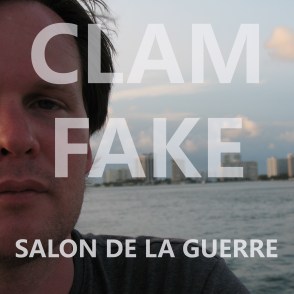
Clam Fake Album Cover_edited-1I hope it doesn’t seem perverse of me, but I like criticism of my creative projects. I used to be a critic and now appreciate the turnabout, which I feel is good for cleaning out any karmic havoc I might have caused. Here’s a not-entirely-positive-sounding review of my album, “Clam Fake,” my favorite line of which is “I have to hand it to de la Guerre for giving zero shits.”
Brussels …

Seeing or hearing children in pain or danger is something that has come to cause me physical pain since I’ve become a parent and I’m sure most people feel the same way and have to do something to overcome the feelings of base impotence. Turning your rage on Muslims (or giving power to those who tell you it’s OK to do so) is one of those things you would likely be tempted to do. It’s wrong. It shows an incapacity to understand your own place in the world. It narrates the innocent into guilt by association. And worst of all, it doesn’t even show comprehension of the nature of the attack today, which in Brussels specifically concerns a matter of assimilation of minority communities. Trying to recreate those conditions here does no favor to the living and does not honor the dead. My heart goes out to Brussels, as an American and as a person who has lived in a city targeted by terrorists.

A new study from a prominent journal by an expert of some kind was not paid attention to today because a voice in your head you have not identified as your father’s told you not to believe it.

The study concerned an important matter possibly relating to public health, economics or political strife but was not received due to the insistent reflex inspired by a husky Dad voice buried deep in the cerebral cortex warning you that it was not content he would approve of. This triggering voice first entered your sub-conscious brain when you were a child and continues to influence executive cerebral and limbic systems of your body (as well as the house-cleaning functions performed by your digestive system) and thus will not allow you to receive this important breaking news on a topic of critical importance.

The study was full of useful statistics and percentages that might help you adapt and make contingencies for emergencies, as well as anecdotal evidence relating to something that might affect your financial status or one or two ways you might not use a hammer, but its salient points were masked to you by the persistent social conditioning you received by a certain grey eminence whose early rules set down as an exchange for simple nourishment were indispensable for a helpless young homo sapiens facing a hostile world of animals. This conditioning severely affected your ability to assimilate new information, mainly because of the gruff, stern tone of the hunter gatherer, as well as implied and now subconscious threats that a challenge to him meant risking the loss of family members and peers and their body warmth—things at the time critically important to a child’s survival and well-being.

“We are definitely headed for trouble,” said a credentialed and educated person whose face you could barely be brought to look at as he or she offered countervailing information that challenged the prevailing norms, value systems, semiotics and archetypes laid down in your neural pathways by the patriarchal strongman and lawgiver whom you still in moments of stress and discomfort call “Daddy.” The story mentions several things you could do to address the critical issues raised by this news story, which might have been about gold prices or the flammable liquid in your house but whose message conflicted with your father’s opinions and threatened to upend the folkways and learned behavior that are now an immutable part of your psychological profile—offering you your ego, your identity and cultural belonging and likely your entire concept of self, a sense of belonging your brain feels is vitally necessary on this tiny planet totally alone in the universe and vulnerable to expanding stars, asteroids and heat death. As the spirit of your father says, there is a heavy price to pay by questioning tribe loyalty and listening to the plea of an outsider that you listen to him about this important topic which might be about lead toy paint or STDs or municipal bonds or global warming but which is not, unfortunately, powerful enough to get through your impressively large Dad-filter or appeal to your brain’s otherwise rugged and impressive neuroplastic cells.

“The time to act is now,” said a person of authority, perhaps a politician or priest or business leader, “but there is only so much time we have before it will be impossible to act on this [issue your dad has already made up his mind about] whose dire consequences cannot be minimized, unless it is by the comforting and unrelenting voice that gave you the gift of fear when you were still learning to crawl, the voice whose dissent against which offers perilous pitfalls, sickness and likely a hideous and prolonged death.

Media Monopoly

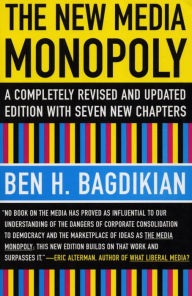
In journalism school, in a class on ethics, we were assigned to read “The Media Monopoly,” a thoroughly depressing screed about the onset of media consolidation with dire, unrelenting bad news that we young journalists were about to enter a field of whoredom owned by a handful of self-interested media conglomerates. These companies were filtering out far-ranging, dissenting voices (it was a prep of sorts for Noam Chomsky’s “Manufacturing Consent.”) It left a big mark on me. The book’s author Ben Bagdikian has just left us now.  RIP. (You can read his obituary here.)

I feel two ways about his book in hindsight. In one sense he was absolutely correct: Most of the big media is owned by the same conglomerates who pollute our water and build war materiel and would indeed like to keep us in the dark. At the same time, the Internet has recreated journalism as cottage industry where even the most extreme voices (communists and global warming deniers alike) are free to put their wares in the marketplace of ideas and have them amplified. That’s given us the multiplicity of voices, but it’s also given us a lot of echo chambers for aspirational opinion havers to confirm their own biases with selective research. To the new voices, pretenses to objectivity are boorish, arcane and disingenuous. The kind of serious investigative, bias-free journalism we used to rely on from professionals becomes harder to find and fund, and must often be paid for by philanthropist billionaires –the patronage of the modern tech Medici. Meanwhile, a lot of old-time professional journalists are simply getting out of the business because there’s no money in it and going into PR.

The Internet age has led us to a kind of anarchy of opposing realities where you can choose your own facts and deny things that are indisputable–global warming, the Sandy Hook massacre or the fact that the Sept. 11 attacks were planned by Muslim extremists. The Internet has given people the confidence to say they trust nothing they read. But it hasn’t confronted them with the consequences of that sentiment: You now have more work to do in scrutinizing what is real by taking multiple viewpoints into account and understanding your own subjective interference in it, including the value system given to your by your peers and parents. Somebody somewhere on the Internet right now will be very happy to let you off the hook for this work by coddling you and your values, and in this you are just as manipulated as you would be by General Electric trying to bury a pollution story.

In this light, the handful of sober conglomerate voices Bagdikian warned us against don’t look all that bad, frankly.

But here we are. Change is change and not to be judged, least of all by me. Powerful money interests have lost a great deal of power over information. It happened quite naturally in a technological upheaval. Power over it has come back to the people, even sweaty, frustrated schizophrenics sitting on their laptops at night. Many people, however, will likely not know what to do with all the conflicting information they have. They will be confused and they will turn to the people they trust, and once again risk becoming tools of somebody else’s will. They will repeat others’ ideas, not innovate on them, and act as if this is some sort of emancipation. The power only to repeat.

So mission accomplished. Patriarchy smashed. Hope you have some idea what you’re in for.

My Music Site

I am pleased to unveil the website for my music project Salon de la Guerre, now up and running at salondelaguerre.com

Check it out.