The magazine was dripping with innuendo
It promised nipples and betrayal
The moon and Page 6 asked my hormones to dance
“You’ll never guess where Tom Kaulitz and Heidi Klum ….”
Began the headline I didn’t finish.
The magazine was dripping with innuendo
It promised nipples and betrayal
The moon and Page 6 asked my hormones to dance
“You’ll never guess where Tom Kaulitz and Heidi Klum ….”
Began the headline I didn’t finish.
Posted in Poetry | Tagged Heidi Klum, newspaper, Page 6, poem, Poetry, tabloid | Leave a Comment »
The train coughed off its riders
Who would watch hockey or meet a friend
Or hoped to meet a girl
Some had been drunk on the train
To get ahead of the way they hoped they’d feel
A young teen explained to his friend
How to mug Long Islanders
“They’re so stupid, when you stare at them,
They just give you their money.”
Another woman chatted
As loud as she could
In the quiet car
And for a while it was enough,
For me to just watch the city
The firework box of surprises
Then I went to the street corner
And yelled “fuck” as loud as I could
I heard once the bulls of Pamplona
Like to knock spectators off the walls sometimes
And gore them.
And I remembered, no matter what city you’re in,
You really should participate.
Posted in Poetry | Tagged crime, Long Island, New Jersey Transit, New York, poem, Poetry, quiet car | Leave a Comment »
 My 21st album, From Sour to Cinnamon, is now available on iTunes, Amazon, Spotify, CD Baby, and other places where music is (still) sold. As I’ve written previously, it’s an album of pop songs with some dark undertones.
The album art was provided by my 8-year-old son Xander.
While the last Salon de la Guerre album displayed my recent obsession with country music, this album is all pop, and most of it was generated with keyboards in Garage Band (though I play guitar on the the song “A Kid’s Inside,” an ode to youth and play and silliness and joy).
Again, all songs written, performed and produced by yours truly.
Enjoy one of the latest tracks here:
Posted in Music, Salon De La Guerre | Tagged A Kid's Inside, Alternative rock, Amphibious Grandkids, From Sour To Cinnamon, pop music, rock, Salon De La Guerre | Leave a Comment »
The little boy played
The piano
Sad and cold and blue
Like he was on a ferry pulling out
Leaving you behind on the pebbly North Fork
Dressed in clouds hiding their tears
Posted in Poetry | Tagged Long Island, North Fork, piano, poem | 2 Comments »
“That congressman is just a lickspittle, I said
“Lickspittle,” whispered my friend. “Lickspittle.”
He didn’t know the word, but he repeated it
Back to me
He had only heard the new word
Not my sentence.
He would try it out
In new conversations. Get it wrong
The first two or three times.
But he would improve his conversation
By using it as often as he could
When he talked to others
And by that I mean,
Improve the conversations with himself
I was glad I could help that relationship grow
Posted in Poetry | Tagged lickspittle, poem, Poetry, Politics, words | Leave a Comment »
I read about monetary easing
And thought of a guy painting a house
Who didn’t give a shit.
He was mad at trans people
He didn’t think of the Fed and his paycheck
He was thinking about chicks with dicks and bathrooms
And he was caught in economic deflation
And the degraded value of his labor
And the asset inflation made him wiggle like a mosquito
in a spider’s web
And yet he’s not thinking of excess trading value
It’s all those dicks, he’s thinking to himself, wriggling around
In an invisible dance of dollars.
Being pushed from job to job, house to house
The dollar making him whip it out, I mean his money,
And buy more expensive
Cigarettes and beer and chicken and barbecue
While people laugh at his overalls
And tumescent paintbrush
“All those breasts and dicks,” he keeps thinking.
Posted in Global Affairs, Poetry, Politics, Uncategorized | Tagged Antonio Gramsci, culture, dollar, Federal Reserve, monetary easing, Politics, transgender | Leave a Comment »
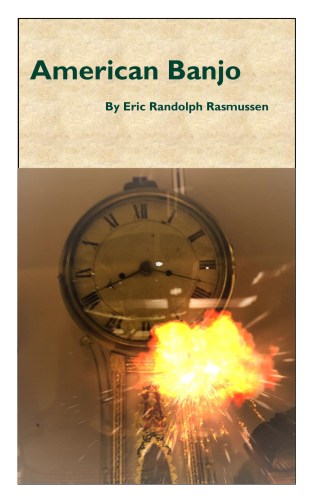 The following is a passage from my novel American Banjo, a story about several generations of an aristocratic American family. It was released earlier this year on Amazon.com.
From the diary of Sandra Eccles:
There is a simple elegance to life. There is a simple elegance to a good mystery. You jump on a ship looking for adventure, looking for drama, looking for meaning. And just as you find the object of your desire, your desire evaporates. I seek drama, and I find drama.
I think of Occam’s razor; the simplest explanation is the best one. The simplest way to write a sentence is the best way.
I wonder if I’m mature enough to live my life simply. I start to think of my father. I hate to think that he might have been right. That my defiance was a play I didn’t understand, and now that I do, the defiance means nothing. But you negotiate the paths to wisdom only through action, through praxis; you may climb a mountain only to find there is no longer a mountain to see. That is mountains. And that is philosophy. The journey was the thing. It was good you made the journey. But the wisdom isn’t what you found. The wisdom came from knowing you had to look.
I think about this after returning home and gazing upon the sleeping, topless figure of the woman who tried to steal money from me—the woman who is now my wife. How we got here is not important. I’ve walked through different rooms of life with her and the room we started in has been demolished. I can no longer know the me before Sieglinde. Nor care about who she was before or who I was.
She wasn’t a thief as I found her. She was asleep. People who sleep are innocent.
I had seen Priscilla earlier that day. Priscilla, the doyenne of my scene, the brilliant lawyer who had helped establish the intellectual underpinnings of “judicial interpretation as violence,” the woman who rebelled through textures, seemed to have become sweet on me … as a mother or something more.
“I have to say, when you were at the party the other night without Sieglinde, I began to worry.”
“About?”
“You two have been together for what … 18 months?”
“Two years.”
“What do you talk about?”
“It was a relationship born in a crisis. We emerged from that together.”
“Crisis isn’t a value.”
Priscilla pushed my hair back where she thought she saw a bruise or something. I pulled away. Evidently, she’d heard things.
“Is this an intervention?”
“I’ve come to care about you, Sandra. You’re focused. You’re ambitious. You hurt Sieglinde with a curt remark and don’t notice. She watches you talking to other women.”
“I can’t think about that. This is my book. My career. I won’t be stopped.”
“But she’s your lover. What if she wanted you to stop? For a baby, maybe.”
“I can’t be held back by that.”
“So leave her.”
I snorted a bit.
“I can’t do that either.”
Priscilla, wiser than anybody I’d ever met, waited for an explanation as she sipped her green tea.
“I can’t do it because she was the one who made me what I am. She brought me out.”
“Which makes her not even as important as your mother, who you probably wouldn’t respect anywhere near as much. You really feel as if you owe her your life? The way a child owes something to a parent?”
“Yes, a little.”
“Well, sooner or later, a child can’t owe something to a parent. She must know that what a parent gives to a child besides life is something more precious. Eventually, the parent must give that child freedom. That’s part of the contract.”
“In what law? Not the Torah?”
“In life. In love. You can’t sacrifice yourself for Sieglinde. You don’t owe her your soul. You don’t owe that to anybody.”
“Stop. I won’t do it. I won’t cut her loose.”
She didn’t talk for a long time, then finally …
“There are other people who want you,” Priscilla said. “Women who want to be with you. Who see your value. You don’t have to compromise. I found out a long time ago, even before I left my husband, what it means to be a whole person.”
“And what’s that?”
“Nobody can take on the responsibility of making you happy. And you can’t take on the responsibility of making somebody else happy. It’s too much to ask. And if you do, you’re not really allowing them to live up to being fully human.”
I drank tea and listened, and she pushed my hair back again.
“Cut her loose.”
Copyright 2012.
Posted in Fiction | Tagged American Banjo, art, art theft, banjo clock, Eric Randolph Rasmussen, Fiction, Nazis, World War II | Leave a Comment »
The long line of cars fed the Lincoln Tunnel
Drivers were transfixed on their anger
A CD player played the sacred syllable “Om.”
While Shiva fed the digesting tunnel with destroyed memories
The tunnel and god-restored
River, the cold blue baby
Forgot who you were again, didn’t you?
There is no driver
There is only a constant forgetting of how to drive
Posted in Poetry | Tagged car, drive, Lincoln Tunnel, New York, om, poem, Poetry, Shiva, Traffic | Leave a Comment »
Understood, she said
But she didn’t understand.
Message received, he thought, but they were
Using terms differently.
My green isn’t your green
My over isn’t your over. My silence is only my silence
Not your aggression.
You argued the words
And missed the sentence.
“Stupid” sounds worse to her than it did to me.
“I love your body” sounded like I didn’t love her mind
The resonant frequency of the building was ineluctable
The bridge jumped
Dissonance was the music.
You cannot live with two sounds now
You must go out
And live among the many
Posted in Poetry | Tagged dissonance, Music, poem, Poetry, Relationships, Wittgenstein | Leave a Comment »
 Beauty is Imperfection