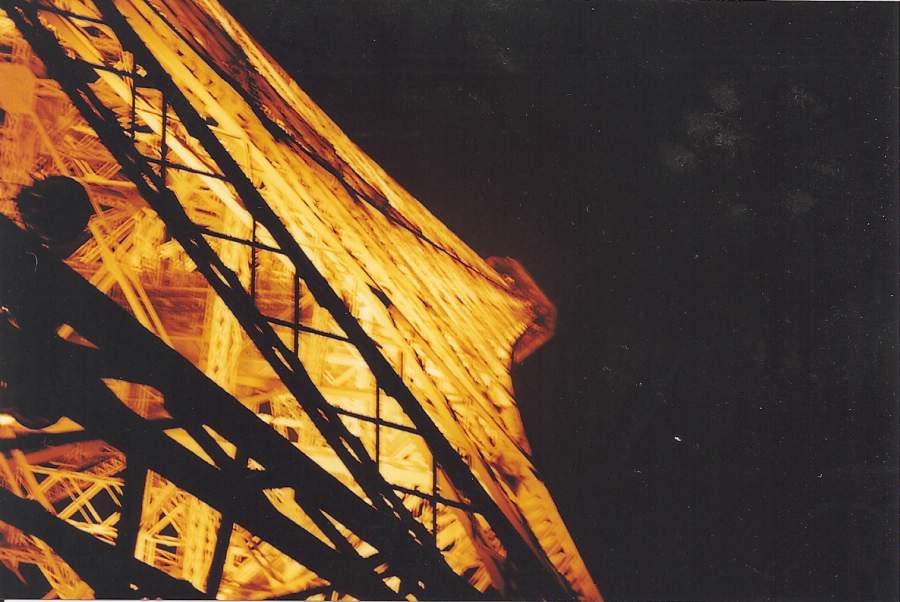
 I’m hurting for Paris right now. Though lots of people are, I think New Yorkers who lived through 9/11 (and maybe those in Madrid and Mumbai) are feeling it perhaps a bit more acutely. There’s something about living in a big city. Contrary to popular belief, it doesn’t just make you some jaded creep. You live every day as a certain trust exercise with people in very close proximity. You constantly meet people with different accents and languages and backgrounds and amazing life histories if you bother to ask them questions. To negotiate this kind of maze requires humility and respect and reserve. You are all sitting on top of each other in sometimes cramped conditions and you have to make it work, and that requires in many ways boundless optimism. Your body comes to know patience and forbearance and you marvel that something so big and complex can work at all. To be that close to people and to have members of a sick cult betray that trust, violently, is something that made me physically ill after Sept. 11. And I felt it a little bit again tonight after seeing the images from Paris, a beautiful city I once visited and hope to again.Eiffel Tower
Posts Tagged ‘9/11’
Je Suis Paris
Posted in Global Affairs, tagged 9/11, attacks, Paris on November 14, 2015| 1 Comment »
Republican For A Day
Posted in Global Affairs, Politics, Uncategorized, tagged 9/11, 9/11 Truther, September 11, Truther on September 13, 2011| Leave a Comment »

The 9/11 Tribute In Light
This is a bit of an update to yesterday’s post. The cowards at “The Rumpus” didn’t post my comment. So you can officially file that site under the heading “Glib, small-dicked wussies masquerading as dissenters but secretly afraid of dissent.” Yes, a cumbersome file name, but I’m not much of a bureaucrat.
Again, I’m not one for sad anniversaries, but I have noticed that I do commemorate 9/11 in a very special way. Every year, I seem to become a Republican for a day. This isn’t by design; it simply seems to be the nature of the arguments I have. When far leftists tend to discuss Sept. 11, they usually have one of two problems: 1) Even if they kindly acknowledge it as a mass murder (thanks, pinkos!), they still have to carefully couch their language so that it meets the prescriptive of their doctrinaire worldview (America’s behavior on the world stage means this action was understandable). Or 2) They deny we were attacked altogether and insist 9/11 was an inside job.
I tried to pulverize that first argument yesterday, though I left out a couple of side notes: If the writer for the Rump Ass considered his “compassionate celestial” view more carefully, he would have realized that a celestial view isn’t a compassionate one at all. It’s simply indifferent. I would challenge the writer to interview a family member of one of the 9/11 victims, to ask specifics of how their loved one died, and then dare ask the question: “Did you know, when your husband ran back into the building to save those last three people on the stairwell, who America was giving money to in El Salvador in 1983?” As it happens, I did interview family members after 9/11. It caused me great anguish because I felt their pain in many ways was none of my business. I should have known, however, that I was helping keep their memories alive. This clod at The Rump Ass, however, brags about his unfamiliarity with those who died, and therefore his Wittgenstein-like refusal to speak of things he knows not. It’s for a very simple reason. If he ever had to interview a family member or write a profile of somebody at Cantor Fitzgerald who died instantly and had never even heard the name Osama Bin Laden, he would go back and look at the horrible article he wrote for the Rump Ass and he would destroy it. He would print it out and dip it in kerosene and burn every word and bury the ashes in quicklime. And he would have wished to god he had not spoken with such glibness and vanity about compassion being selective. He would have realized he traded empathy for doctrine. This guy says, 150,000 people died around the planet on 9/11, so why are 2700 Americans special? Should I similarly disregard anybody who died in Rwanda in 1994 because each of those days saw thousands of deaths elsewhere? Does it not bear remarking that most people don’t die horrifically everyday for political reasons when they are struck down by machetes or trapped in buildings that have turned into ovens? The Rwandans just wanted to kill each other, so why should I care or hope my government should do anything about it? If the author chooses not to show compassion for political reasons on 9/11, then he would have to spread that dispassionate view equally to Rwandans. Can he? Would he?
But let’s look at No. 2, the 9/11 Truthers. I was once working with a filmmaker from Germany on a Long Island movie, and we hit it off. Then on the subway ride home he tried to convince me that no men in caves could have brought down the Twin Towers, and that it was obviously a controlled demolition. I was thoroughly disgusted. It was a bit like finding out you’ve hit it off with a racist or an anti-Semite or a cannibal. One of the first things any engineer, philosopher, writer, linguist, philologist or doctor would know in his respective field is the rule of simplicity. It’s called Occam’s Razor and it means you don’t overcomplicate simple insight to fit a theory. Engineers don’t try to improve on the Pythagoras theorem by changing the numbers in gravity. Writers don’t come up with a hundred jargon words to say “The dog walked down the street.” Doctors don’t triple check a broken arm by opening a person’s heart. And a real thinker doesn’t remove the plane from a plane crash. This is logic so simple that my infant son would know it. And yet every time I’m on this here CB radio called the Internet I must confront people who say that the Twin Towers were brought down in an inside job, theoretically because g-men had days and days and days to plan and ably overcame bureaucracies and witnesses not noticing the tons of explosives being placed around the complex. The smoking gun: George Bush wanted war in Iraq. Therefore he destroyed the towers. There. It’s proved.
The fact that so many Americans believe this is truly chilling. These people are also, we presume, driving cars and raising children and handling knives. If you point out the fallacy, post hoc ergo propter hoc, they have the easiest retort in the world–they simply add you to the plot. Dehumanize you and your argument. George Bush has programmed you. It doesn’t occur to them that if you simply agreed with them to avoid confrontation, you would be much more of an automaton, much more a tool of somebody else’s will.
Why do people complicate simple insights? Helplessness. When the world seems bigger than you are, when you personalize complex events and the world makes you feel small, vulnerable, feckless and inferior, a conspiracy theory is one of those things that gives you false sense of power. You are suddenly part of a group of people who know a secret. Having joined a group, having become a joiner in the worst sense of the word, you ironically enjoy a feeling of false emancipation. You think you are a free thinker, even though you haven’t done the work free thinking requires: due diligence, proving steps, finding chains of causality, finding the simplest explanations. Having your ideas put up to scrutiny.
It is doubly repulsive because the Truthers, I think, are the people who made the world safe for another detestable “-er,” the Birther movement. I see these two buds inextricably intertwined like roses on a trellis. It was the Truthers who created a toxic polemical environment where even proof of Barack Obama’s citizenship with a birth certificate was no longer proof. Witnesses were no longer witnesses. Hospitals are no longer hospitals. Hawaii is no longer a state. The real insight is that Barack Obama is black, and so how could he be president, ask the Birthers, of “our” country. The same logic is at play with Truthers. “George Bush wanted a war, so how could 9/11 have really been plotted by the people like Islamist extremists who made categorical confessions of their own guilt?”
The rest is window dressing. Truthers pull out lots of meaningless specific heat capacity calculations to prove their theory that paper fires don’t melt steel. You try to tell them that steel doesn’t have to melt in order to stop doing its job, and for that you’ll get called a Manchurian candidate. Or they point out that falling debris can’t fall down on top of more debris with the speed of gravity because the building itself is “the path of least resistance.” In other words, the Twin Towers should have fallen over on their sides if they were destroyed by planes. Never mind that a house of cards wouldn’t fall over “on its side” if you knocked it down. Never mind that if you watch videos, the impact points of destruction start from the top and move down, where the falling floors cumulatively add new destructive weight, whereas controlled demolitions start from the bottom (using gravity as a weapon, perhaps the best weapon). Raise your hand if you saw the Twin Towers crumble from the bottom.
But again, by getting into these arguments, you remove the planes (some people actually try to do that too, by making 9/11 the world’s greatest advertisement for PhotoShop ever). To remove the planes makes you a non-thinker. A partisan who places himself at the center of a paranoid web of strange facts and non-facts. I’d feel better frankly, if many of these people just admitted they were lying. Then they would merely be scumbags. Instead, they poison the sort of thinking required of enlightened individuals to synthesize, dialectically, a better world. They’re making us all stupider.
I thought to further my contribution to a better world, I might offer some of the better Web sites debunking the Truthers. Here is one from a site called “Implosion World.” They say they are independent. So to Truthers, that means they’re probably part of the plot.
And then there’s this wonderful YouTube video that gives common sense descriptions of what happened when the planes hit the towers. If you are a non-Truther, I bid you a nice time enjoying your brain.
An Awful Article About 9/11
Posted in Global Affairs, Politics, tagged 9/11, The Rumpus on September 12, 2011| 1 Comment »
The 9/11 Tribute In Light
It’s human nature to politicize things that ought not be politicized–even the weather. I have personally come to believe that politics is not evil incarnate or the instrument of the devil, as Bob Dylan once put it, but as natural a process as cell division in biology. Some day, a scientist will show the direct parallels between a cell’s meiosis and a polity dividing. It starts with memes, symbols, words, and codes. Soon, people are debating, disagreeing, self-identifying and self-segregating around those semions, just as surely as haploid cells divide in meiosis. Because I’m not a scientist, I had to content myself with writing a novel about this process. It’s called “The Ghost and the Hemispheres,” and I’m shopping it to agents now.
But we are political and we do seek out political differences, perhaps because of a genetic imperative to innovate. That’s why I should have expected a horrible, recrudescent strain of 9/11 backlash articles like this shitty one. Like a good leftist speaking in the codes of his faith, just like Michele Bachman does to her flock, the guy runs at the mouth with a lot of the same predictable schtick about the evils of American exceptionalism. Not stopping to figure out that it was outsiders who decided to single us out in 2001.
Maybe I should confess that I agree with 20% of the piece, specifically the idea of Sept. 11 as a dubious cultural rallying point. I have not been much enamored of the 10th year anniversary memorials for 9/11. The author calls it the “pornography of grief,” which is a nice touch. But mostly he slips into the kind of pedantic, “told-you-so” moralism that characterized the far-left writings after 9/11. Lest we forget, this kind of attitude smeared the entire left wing in 2002 and 2003 and allowed warmongers to launch their immoral war because they could easily con the political center into thinking everybody on the left was crazy. As a left-winger, I get pretty torn up when liberals are wrong, as many of them were when they said the United States deserved the attacks in New York and Washington for all of its sins. I’m sure there’s a folksy phrase for this fallacy: Maybe killing Peter to pay back Paul. So I wrote this long tirade in the comments section of the Web site:
“This is an execrable piece. A piece that trades one fell morality for another like chips in a poker game, when in fact, as none of you can evidently see, the writer is willing to abdicate his morality altogether to settle petty political scores. He is unwilling to apply a simple categorical imperative that the murder of thousands of innocent people for religious reasons is wrong. If you think the Iraq war was wrong, as I do, for the simple reason that the United States wasn’t attacked by Iraq, then you must be willing to assert that the murder of thousands of Americans in for one man’s specious political calculation and religious chauvinism was wrong. The idea that “they hate us for our freedom” is stupid. The idea that Osama Bin Laden’s motive was the freedom of the Palestinians, whom most of the Arab world regularly spits on, is just as stupid. Bin Laden built himself up on American power and then turned on it. He decided to make thousands of Americans victim of an internecine squabble with his own government. To make him the moral voice of the oppressed Vietnamese or the Chileans is an act of stunning stupidity. But let’s talk about your celestial view. Isn’t Putting 9/11 into “perspective” a bit like putting the Manson murders into “perspective”? Yes, it was sad that a pretty pregnant lady got stabbed, but Charles Manson was right, the black people are oppressed, while rich white people are drinking champagne. This article offers the supreme intellectual dishonesty that anybody who lives in the United States and is willing to walk into a tall building, even to work, is worthy of being burned to death by jet fuel or defenestrated from the 87th floor for what has happened in Nicaragua, East Timor, Panama, Angola, El Salvador and Vietnam. There is no philosophy or ethics or morality that wouldn’t collapse under the weight of this viewpoint, and for the author to invoke unnamed children dying in huts is particularly pitiful; he’s not making the point that people should be equal but that misery should be. It’s anti-humanism at its worst. And if the author stops to think about it, it’s also an imperialist outlook. He’s not speaking FOR anybody. He’s just speaking against the United States as a sometime participant. And knee-jerk anti-patriotism is just as bad as knee-jerk patriotism. You all let that sink in. If you can. We all grieve in different ways; some of us get over it more quickly than others. I live in New York and did not choose to watch all the coverage tonight because I don’t want my grief to be preserved in amber. But if somebody else decides they want to be part of the grief–to give to charities, to comfort friends or to simply imagine that it could have been them (because if you’re an American, it could have been), then that’s his choice. If you decided that you did not belong to a country that day, that’s fine too. But be warned: you’re sounding a lot like a Tea Partier, who gets to pick and choose when he belongs to a commonwealth or the human race. The Tea Partier may decide to opt out when its time to help fund health care for everybody, but you, my friend, have decided to opt out when it comes time to show pain for 2700 people dying all at once. So today, you have made the Tea Party look good, the left look bad, and put your hatred on display for all to see. I only hope they can.”
I don’t normally read this site, and I don’t usually pick fights on bulletin boards, but usually keep my polemics to myself at this, your 24-hour Rasmussen station. But when my Facebook friends on the left started coughing up some of the old shit from their scarred lungs, I decided to go ahead and speak up. To lie down and do nothing while somebody is selling you a bill of goods is … un-American. And on certain occasions, I’m proud to be one.
Remember …
Posted in Global Affairs, history, Self Absorbed Ramblings, tagged 9/11, September 11 on September 11, 2011| Leave a Comment »
The 9/11 Tribute In Light
Here’s something I don’t post very often: A story I wrote almost ten years ago–five short bios of rescue workers who died at the World Trade Center on Sept. 11, 2001. As I posted last year in a more personal account, the Sept. 11 attacks caused me, at the time a not-so-serious journalist, to confront a more serious world. One of the hardest things I was asked to do by editors at the time was call up bereaved families while the story was still in progress. For a long time, I shrank from that task. Chasing grief was not something I had ever wanted to do as a writer in New York City; all I had ever wanted to do was be creative. But with mayhem all around, with ashes of the iconic towers snowing down on my neighborhood and with no real idea of what I was doing, I had to finagle a subway ride into Manhattan and go interview people. I had to come to grips with my limited talents and see if there was something (anything?) I could offer the world as a writer to deal with something so monstrous and inhuman when I’d led my life before chasing whimsy. One wonders at a time like that how competent he is, how necessary in the vast scheme of things, when all around there is need and he hasn’t prepared himself. One wonders, I hate to say, about things he hoped he’d never have to, even about topics he’d shunned since his teen years. I wondered for a time what is masculinity, and would I have served the world better as a warrior or a burly firefighter rather than a cowering writer in my garret. These are the psychological wounds that 9/11 inflicted on some of us, too.
And as I confronted these problems, nearly wanting to collapse with heartache, instead, I made myself write something; I made myself be part of the world.I’d ask you to click the first link to see the brave men (and women!) who didn’t have to think about it, because they were too busy acting on instinct to save people, and for that died.
Closure: Bin Laden a Has-Bin
Posted in Global Affairs, tagged 2001, 9/11, Barack Obama, Osama bin Laden, Osama bin Laden dead, Pakistan, Sept. 11 on May 2, 2011| Leave a Comment »
The 9/11 Tribute In Light
I was about to turn off my computer late Sunday night after resting my eyeballs on some mindless TV when all of a sudden, a quick scan of the New York Times shook my peace and ruined my planned sleep. Bin Laden dead. Bin Laden killed. He’s bin terminated. He’s a has Bin. He’s bin there done that.
The Upper East Side, the sleepiest part of the city that never sleeps, had already gone to bed. Two hours after the announcement, I’m still looking out the window on my beautiful city and its always changing landscape and seeing no gathering of people. The local ABC affiliate immediately ran out to Times Square after the announcement and the reporter gushed that it was filling up with people. Behind her, trash blew around in the deserted sidewalks. I highly recommend this clip to the producers of “The Soup” and perhaps Columbia Journalism School graduates who want to learn how to avoid embarrassing themselves.
But put aside the levity and let’s attack the meat of the matter: The man who slaughtered almost 3000 innocent Americans 10 years ago is dead. The man who was willing to exploit American power for his own ends in Afghanistan until he decided he’d rather murder American civilians to impress psychopathic Islamic fundamentalists–is gone. The man who evaded capture for 10 years and told us what his real aim was–the restoration of the caliphate along the lines of the repressive Taliban, is obliterated.
I am one of those people who has never believed in the concept of closure, whether it’s political, spiritual or even romantic. People love closure the way they like crack–they promise this time is always the last time, and yet they always seem to want more of it after it’s over. So when my wife said to me tonight, as we watched the updates on ABC, that this entire thing felt anticlimactic, I knew exactly what she meant.
It feels that way for several reasons. One, the war is not over. Al Qaeda, what started out as an agreement over a table a couple of decades ago among a few rogue military leaders, one of whose rules was to have good manners, has metastasized into several networks with different leaders all vying for prestige and leadership over a restive culture of America-haters. Two, the relatively bloodless dispatch of Bin Laden in a raid on his compound in Pakistan reminds us of something we have all forgotten: He was just a man. He was not a God. He was not a country. He was not even much of an army. One of the biggest tragedies of 9/11 is that it showed us how a relatively small group of people can cause so much harm. We were attacked by a club, a mafia even, and the justice meted out was never going to compensate emotionally for the pain inflicted. It’s for similar reasons that we can’t accept the idea that Lee Harvey Oswald may have acted alone: How can one puny, limited, brutish person cause so many hopeful people so much grief? It’s for denial of that reality that America inevitably overreacted to 9/11 by invading not one but two countries, one of which had nothing to do with the attack.
The next reason it feels anticlimactic is that we will never get back the people we loved that day. As President Obama said, children are still missing fathers, husbands missing wives. Friends missing friends. The death of one man can’t make up for the pain of that either.
And finally, the reason bin Laden’s death feels anticlimactic is that we waited so horribly long for the day to arrive. For ten years, we had to live with the idea that the man who openly admitted to plotting the destruction of the World Trade Center was indeed sitting somewhere exactly where we imagined him–not in a cave fighting hand to hand but in a comfortable compound in Pakistan, in the nurturing bosom of friendly Pakistanis–drawing ten more years of breath. That was 10 years for many of us to get comfortable with some uncomfortable ideas–that life isn’t fair. That a mass murderer might indeed go unpunished. When George Bush announced at one point that bin Laden had been marginalized and was no longer a big deal, you might have read it the same way I did: He was practically promising that this account would not be reckoned. Now the mass murderer is indeed gone, but the uncomfortable idea remains. What if there had been no tip off last August? What if bin Laden had lived to a ripe old age? It was entirely possible. There were lots of Nazis, after all, who died peaceful deaths after spreading out to the four corners.
I think about this as I look at many of the faces gathering in Washington and Lower Manhattan on television. Many of them are young adults. A lot of them seem to have even been children in 2001. For them, 9/11 was likely the single most important political and philosophical experience of their lives, the event that forged their characters and their morality. It would be much harder for them to live the last 10 years with the same existential unease–that an evildoer would prevail. It doesn’t matter whether they lived in New York City and watched the World Trade Center smash into the ground (as I did) or whether they are willing to put the events in some sort of historical context (which I try to do, as painful as it can sometimes be). For them, bin Laden simply couldn’t be walking about freely in a moral universe. He had to go. I felt that way at one time. I was 31 on Sept. 11 in 2001 and the attack drove me to a despair I’d rather not describe. I had a hard time sleeping for a long time and the sound of planes gave me the creeps. For a few months, many New Yorkers lived with a grim, almost mordant pessimism that the end was near. But my hatred for bin Laden and my desire to see his lifeless corpse dragged through the streets behind a chariot yielded after a while. That kind of hatred did me no good.
But anticlimax or not, we’re still fighting a couple of wars (though Iraq is winding down). And probably the most important question raised by Osama bin Laden’s death is now this: Why are we over there? Osama bin Laden was for so long the answer to that question that you needed little other. But now the palimpsest has been erased. The central premise of our wars overseas has been removed. Though we might still be fighting networks that mean to harm America, we’ve now reached the point in which we remain present only to fight those who fight against our presence. The idea of Afghanistan slipping back into a Taliban-ruled violent, repressive theocracy is repugnant, but so are the accidental killings of civilians and the razing of towns by American forces and the funneling of American money into the pockets of Taliban leaders through public works projects. Now is the time to save face and ask if it’s time to leave. Barack Obama can have his own “Mission Accomplished” moment if he likes. It’s no sin to bug out if what we’re doing in Afghanistan is counterproductive and we got what we came for.
But I’ll sign off with this thought–I’m proud of my country tonight. As I was about to drag my sorry ass to bed, part of me wanted to throw on my clothes and go downtown at 2 in the morning to cheer with my fellow New Yorkers the removal of Osama bin Laden and his hatred from this planet. There is a narrow, joyless view that everything America does it does Energizer Bunny-like for money and oil. Sometimes, it happens, I’m sure. But a more expansive view might allow that Americans have altruism in them and that there is a goodness in us that is worth protecting. Naive perhaps, sometimes, about their own role in the world. But definitely capable of good.
Where Was I on 9/11? A ‘Journalist’s’ Tale
Posted in Essay, tagged 9/11, Osama bin Laden, Sept. 11, Twin Towers on September 11, 2010| Leave a Comment »
As I get older, I feel less enthusiastic about marking the anniversaries of horrible events (or even good ones). I hope that doesn’t sound callous, especially since I didn’t lose any friends or family members in the Twin Towers. But at some point, grief becomes self-perpetuating. I have known people who have built entire shrines to their grief as a way of holding on to it. I was familiar with this behavior on Sept. 11, 2001 from reading. I know it first-hand this year after losing my mother in a car wreck. Grief is something you have to let go of. And anniversaries are just one more way of preserving grief in amber.
But for documentary purposes, I’ll tell you that as a New Yorker, I went through periods of shock, depression, mania and denial due to the terrorist attacks, if not nervous breakdown. I’ve heard there are studies suggesting that the closer you were to the towers on Sept. 11, the greater your chances of suffering post-traumatic stress disorder. I was two miles away, for whatever that’s worth. And looking back, I sometimes wonder if I indeed suffered from it, if not from some milder, derivative form of despair.
I was a freelance journalist at the time, living in downtown Brooklyn. I had just finished up a morning Web feed for a financial news site when a friend called and told me to turn on the TV. Seems the World Trade Center had been hit by an airplane. I walked to the Brooklyn waterfront and found not one but both buildings gashed, with flames licking up the sides–vast walls of flames that it takes you a moment to realize are as tall as small buildings themselves. But why two crash sites? I thought at first that maybe one plane had sliced through Tower 1 and hit Tower 2 (though the trajectories didn’t match). The radio said two planes. “That’s impossible. Surely I’m hearing it wrong.” Terror wasn’t in my thoughts.
Though I knew about Al Qaeda and the bombings of the U.S.S. Cole and the African embassies, I never really understood Osama bin Laden, a former U.S. ally whose beefs still seemed too esoteric and obscure to me. He didn’t seem to be a guy fighting against colonialism or for the freedom of his people but rather a self-important freebooter who felt double-crossed by the American military. He seemed so proud, blustering and overly sensitive that he had probably felt double crossed a lot in his life–by the Americans, by the Saudis, by his family. People like that make great sociopaths.
I then made what in hindsight turned out to be a foolish decision. I decided to go back home and call a few editors to see if there was anything I could write about the emergency. I have never been much of a spot reporter, but 2001 was the year I had quit my job with the intention of being more of a go-getter.
So I ran home thinking, again foolishly, that the fires, still burning at that point, would be contained. “Why sit here and watch it burn?” I thought. “It’s not like the towers are going to collapse.” In 1993, the World Trade Center had already been attacked, when a terrorist loaded up a van full of explosives. The destruction underground opened 100 foot holes five stories tall. And yet the towers stood. And a B-25 Mitchell had hit the Empire State Building in 1945 without felling it.
My bad. As we all found out later, the math changes when the most vulnerable beams are all on the outside of your building. They didn’t have to melt. All they had to do was fail. I raced home to find out from the radio that Tower 2 had indeed fallen right where I’d stupidly left it. Shows how good a spot news reporter I am. I ran home from the real story.
I then sallied back outdoors to see from my cramped Brooklyn vantage point what Lower Manhattan had turned into. Many TV cameras have caught the images of that day, so I doubt I could do them justice with poetic ruminations of destruction. But what had been lower Manhattan was subsumed in a dark purple-yellow cloud with some buildings sticking up out of it. It looked as if part of the sky had been erased by a furious illustrator unhappy with the work he’s done. But it was obvious from the columnar shape of the cloud that what had been erased was a building.
A guy nearby on the Brooklyn waterfront said “I know there’s a God now because I’m over here and not over there.” It sounds horrible, but the graveyard humor started before both towers had gone down.
I headed north to my friend Michael’s house. He lived much closer. Before I got there, it started snowing–not precipitation but pulverized concrete, getting into my eyes and piling up on the cars. Winter in September. And overhead of course, the lighter material was flying away–reams of paper. You could only imagine what was printed on it. Thousands (millions?) of pieces of paper flying away on top of the rising heat. With Brooklyn suddenly enmeshed in clouds of the destroyed Tower 2, I had to go indoors with my friend and watch the final destruction of Tower 1 play out on television like the rest of America. I knew by that point we’d be going to war. Some friends and I went to the water front again when the skies had cleared a bit. “This is the new skyline,” said a guy with a video camera. “Guess we better get used to it.”
I went back home to attend to e-mails flooding into my box from friends and family asking me if I was OK. On the map, I looked very close to the destruction, especially to people out of state.
At some point I cried. I don’t remember what set it off. I think it was a friend’s letter asking me what they could do. I wasn’t sure what to do next, but then a friend from Texas gave me a virtual slap upside the head: “You’re a writer. Write about it.” As it happens, I had only one writing gig at that point at a nurse’s magazine. Not exactly what I had in mind. But they wanted a story. All of a sudden I was a real reporter covering a life and death situation.
So I lay down on the floor and had a panic attack. Not only was I going to have to write about something I hadn’t come to grips with, but I was going to have to become a spot news reporter instantly, which I hadn’t been before. My chest hurt and I felt when I got up like I was going to fall over. At some point, though, I made it to the George Foreman grill, and shoved a piece of chicken into it, then ate the bland, vulcanized thing for the protein. It was the bit of strength I needed to get out the door.
I somehow got a subway train to Manhattan, which coughed me up in Greenwich Village, but most of the routes downtown were barricaded at Houston Street. Nobody was allowed to go south, even if they lived there, and I couldn’t convince the cops to let me through. It was the middle of the afternoon and the day was still, all things considered, quite pretty. The traffic was diverted and in the middle of Sixth Avenue, the usual river of taxis had dried up. In the middle of the empty thoroughfare was a young man who had set up an easel and was splashing across his canvas a giant expressionistic acrylic version of our national tragedy while it was still in progress. More gallows humor (or coping?)
I went to St. Vincent’s hospital and found a press area, defying the press credential requirement and jumping into the pit. I asked doctors and nurses what kind of injuries they were seeing. Turns out, there weren’t many. Sept. 11 was extremely binary in its casualties list (at least during the first day) Either you died or you didn’t. You can read the story I wrote on it here if you like. It’s not Pulitzer material, but it got me through the day.
Drinks were free that night. We told more inappropriate jokes. We asked each other if we were OK. Some people hooked up. Others just walked around. The next day was like a Saturday at Disneyland. People walked around with their kids in a light so soft it was almost impressionistic. People called friends they hadn’t called in years. Even I called an ex with whom I’d had an acrimonious break up. I don’t know why. I had to make sure she was OK.
I met Stephanie a few months after the attack and went back to work full time and can say now that 2002 was one of the best years of my life, following 2001 which was undeniably the worst. I came through it better, but different.
I am extremely clear headed about the political questions raised by 9/11. Whatever America has done in Chile, Nicaragua, Vietnam, East Timor, Angola or Cuba, you can’t possibly take the side of a murderous religious fundamentalist, somebody who wants to revive a medieval caliphate, and think it’s OK for him to murder American civilians to right American wrongs. If you are one of the people who think America had 9/11 coming, I don’t count you much of a thinker. I think of you as doctrinaire and sad.
At the same time, the burden of introspection on Sept. 11 was unfortunately on those who were hurting the most. Only a few brave contrarians pointed out back then that Afghanistan was going to be a mess if we invaded. Now we have that mess. People cried war, because at the time we figured at least 10,000 people were dead and surely that was an act of war. Logic didn’t bear this out, however, since no government per se had attacked us. Ultimately I backed our president’s incursion into Afghanistan because the Taliban were at least undeniably protecting the people who attacked us.
Not so, Saddam Hussein. Americans still in pain 20 months later were still not thinking critically at all, and they let George Bush and his cadre of think-tank neoconservatives take advantage of us by leading us to war in Iraq. We know in hindsight that we were vulnerable to manipulation. It’s very, very hard to say we should have anticipated it from Day 1.
But the political realities are just one thing that have made me grow up. More important was that 9/11 made me realize how much I love my city. Moving here and becoming part of New York with its bustles and frustrations had been a dream of mine since I was little. Learning the city means making it a part of your body–you have to know the rhythms, the steps, the hustles, the battles. You have to know when to step back from the subway. You have to know when to fight city hall and when not to. When you make the city so much a part of your own body, perhaps it just makes sense that you would hurt when it hurts. The strangest thing I can say about 9/11 is that, even though I didn’t lose anybody close to me in those planes or in those buildings, I took the attack very personally. This great metropolis they had built was in my mind, despite its flaws, a paradise. And to see so many ideals ripped down at once–the aspirations of young people, the aspirations of peace makers, and the aspirations of people who build things like tall buildings–was the saddest thing to me as a New Yorker and a young person, too. Soon, I wasn’t young anymore.
Photo: The 9/11 Tribute in Light
Imperatives
Posted in Life, tagged 2001, 9/11, Sept. 11 on September 11, 2009| Leave a Comment »
Here are a few imperatives for you, dear readers, as you go about your day.
This is the anniversary of the attacks on 9/11 2001. I exhort you to do the following:
Live. Breathe. Eat. Hug. Read something. Write something. Tell someone you love them. Make love. Brush your teeth. Go to the bathroom. Walk. Think. Dream. No, don’t just dream. Dream big. Why shouldn’t you? You’re alive. And that makes you the luckiest son of a bitch there is.
Don’t think about what you haven’t done. It’s a waste of time. Don’t think of what you’re too old to do. There’s no such thing as too old. Don’t think of what you’re too young to do. You can do plenty. Don’t think of missed opportunities. While you’re thinking about them, you might miss more.
Take responsibility for your own happiness. Take responsibility for your unhappiness too. If you got up this morning with happiness to spare, share it. Whatever you’re doing, try not to become too obsessed with the end result. Just realize that in the act itself, there is a dignity and the integrity of a living person making his or her way on this planet.
The universe may or may not be a fluke, but you change it just by being here. Time doesn’t exist. Not unless you weave it into something. Make it something good.
 Beauty is Imperfection